
Join Our JEE Preparation Group
Prep with like-minded aspirants; Get access to free daily tests and study material.
Sign in
Please select an account to continue using cracku.in
↓ →
Join Our JEE Preparation Group
Prep with like-minded aspirants; Get access to free daily tests and study material.
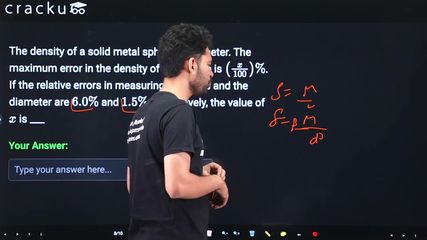
The density of a solid metal sphere is diameter. The maximum error in the density of the sphere is $$\left(\frac{x}{100}\right)\%$$. If the relative errors in measuring the mass and the diameter are $$6.0\%$$ and $$1.5\%$$ respectively, the value of $$x$$ is ___
Correct Answer: 1050
We have to determine the maximum percentage error in the density of a solid metal sphere when its mass and diameter are measured with known percentage (relative) errors.
First, we recall the basic definition of density.
Density $$\rho$$ is defined by the formula
$$\rho \;=\; \frac{\text{mass}}{\text{volume}} \;=\; \frac{m}{V}.$$
For a sphere whose diameter is $$d$$, the radius is $$r = \dfrac{d}{2}$$. The volume of a sphere is
$$V \;=\; \frac{4}{3}\pi r^{3}.$$
Substituting $$r = \dfrac{d}{2}$$, we find
$$V \;=\; \frac{4}{3}\pi\left(\frac{d}{2}\right)^{3} \;=\; \frac{4}{3}\pi\frac{d^{3}}{8} \;=\; \frac{\pi d^{3}}{6}.$$
Now we write the density explicitly in terms of the mass $$m$$ and the diameter $$d$$.
$$\rho \;=\; \frac{m}{\dfrac{\pi d^{3}}{6}} \;=\; \frac{6m}{\pi d^{3}}.$$
Hence $$\rho$$ is proportional to $$m$$ and inversely proportional to $$d^{3}$$. In algebraic form we may write
$$\rho \;\propto\; m^{\;1}\,d^{-3}.$$
To find the maximum (worst-case) percentage error in $$\rho$$, we use the well-known rule for propagation of relative errors for products and quotients:
When a quantity $$Q$$ depends on measured quantities as $$Q = A^{\,\alpha}B^{\,\beta}$$, the maximum relative error in $$Q$$ is
$$\frac{\Delta Q}{Q} \;=\; |\alpha|\frac{\Delta A}{A} \;+\; |\beta|\frac{\Delta B}{B}.$$
Applying this rule to $$\rho \propto m^{1}d^{-3}$$, we obtain
$$\frac{\Delta\rho}{\rho} \;=\; 1\bigl(\frac{\Delta m}{m}\bigr) + 3\bigl(\frac{\Delta d}{d}\bigr).$$
The problem states that the percentage (relative) errors in measuring the mass and the diameter are respectively
$$\frac{\Delta m}{m} = 6.0\%, \qquad \frac{\Delta d}{d} = 1.5\%.$$
Substituting these values, we get
$$\frac{\Delta\rho}{\rho} \;=\; 1(6.0\%) + 3(1.5\%) \;=\; 6.0\% + 4.5\% \;=\; 10.5\%.$$
According to the wording of the question, this maximum error is written in the form
$$\left(\frac{x}{100}\right)\%.$$
Equating the two expressions for the percentage error, we have
$$\left(\frac{x}{100}\right)\% = 10.5\%.$$
Removing the percent sign (which merely indicates “per hundred”) and equating the numerical parts, we find
$$\frac{x}{100} = 10.5 \;\;\Longrightarrow\;\; x = 10.5 \times 100 = 1050.$$
So, the answer is $$1050$$.
Was this solution helpful?
Click on the Email ☝️ to Watch the Video Solution
Create a FREE account and get:
_1.webp)

Educational materials for JEE preparation

Ask our AI anything

AI can make mistakes. Please verify important information.
AI can make mistakes. Please verify important information.
