
Join Our JEE Preparation Group
Prep with like-minded aspirants; Get access to free daily tests and study material.
Sign in
Please select an account to continue using cracku.in
↓ →
Join Our JEE Preparation Group
Prep with like-minded aspirants; Get access to free daily tests and study material.
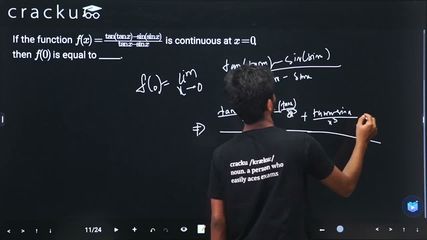
If the function $$f(x) = \frac{\tan(\tan x) - \sin(\sin x)}{\tan x - \sin x}$$ is continuous at $$x = 0$$, then $$f(0)$$ is equal to _____.
Correct Answer: 2
We have to evaluate the limit
$$\lim_{x \to 0}\; \frac{\tan(\tan x)\;-\;\sin(\sin x)}{\tan x\;-\;\sin x}$$
because, for continuity at $$x = 0$$, the value $$f(0)$$ must equal this limit.
Step 1: Expand $$\tan x$$ and $$\sin x$$ about $$x = 0$$ up to the order $$x^{3}$$.
$$\tan x = x + \frac{x^{3}}{3} + O(x^{5})$$
$$\sin x = x - \frac{x^{3}}{6} + O(x^{5})$$
Step 2: Denote
$$A = \tan x, \qquad B = \sin x.$$
Using the results from Step 1,
$$A - B = \left(x + \frac{x^{3}}{3}\right) - \left(x - \frac{x^{3}}{6}\right) + O(x^{5}) = \frac{x^{3}}{2} + O(x^{5}).$$
Step 3: Expand $$\tan A$$ and $$\sin B$$ for small arguments $$A, B$$.
For any small $$y$$,
$$\tan y = y + \frac{y^{3}}{3} + O(y^{5}),$$
$$\sin y = y - \frac{y^{3}}{6} + O(y^{5}).$$
Applying these with $$y = A$$ and $$y = B$$:
$$\tan(\tan x) = \tan A = A + \frac{A^{3}}{3} + O(x^{5}),$$
$$\sin(\sin x) = \sin B = B - \frac{B^{3}}{6} + O(x^{5}).$$
Step 4: Form the numerator.
$$\tan A - \sin B = (A - B) + \left(\frac{A^{3}}{3} + \frac{B^{3}}{6}\right) + O(x^{5}).$$
Because $$A = x + O(x^{3})$$ and $$B = x + O(x^{3})$$, we have $$A^{3} = x^{3} + O(x^{5})$$ and $$B^{3} = x^{3} + O(x^{5}).$$ Hence
$$\frac{A^{3}}{3} + \frac{B^{3}}{6} = \frac{x^{3}}{3} + \frac{x^{3}}{6} + O(x^{5}) = \frac{x^{3}}{2} + O(x^{5}).$$
Therefore
$$\tan A - \sin B = \left(\frac{x^{3}}{2}\right) + \left(\frac{x^{3}}{2}\right) + O(x^{5}) = x^{3} + O(x^{5}).$$
Step 5: Form the denominator (already obtained in Step 2):
$$\tan x - \sin x = \frac{x^{3}}{2} + O(x^{5}).$$
Step 6: Take the ratio and pass to the limit:
$$\frac{\tan(\tan x) - \sin(\sin x)}{\tan x - \sin x} = \frac{x^{3} + O(x^{5})}{\dfrac{x^{3}}{2} + O(x^{5})}
= \frac{x^{3}\left[1 + O(x^{2})\right]}{\dfrac{x^{3}}{2}\left[1 + O(x^{2})\right]}
= 2 \cdot \frac{1 + O(x^{2})}{1 + O(x^{2})}.$$
As $$x \to 0$$, the terms $$O(x^{2})$$ vanish, giving
$$\lim_{x \to 0}\; \frac{\tan(\tan x) - \sin(\sin x)}{\tan x - \sin x} = 2.$$
Hence, to make $$f(x)$$ continuous at $$x = 0$$, we must define
$$f(0) = 2.$$
Answer: $$f(0) = 2$$.
Was this solution helpful?
Click on the Email ☝️ to Watch the Video Solution
Create a FREE account and get:
_1.webp)

Educational materials for JEE preparation

Ask our AI anything

AI can make mistakes. Please verify important information.
AI can make mistakes. Please verify important information.
