
Join Our JEE Preparation Group
Prep with like-minded aspirants; Get access to free daily tests and study material.
Sign in
Please select an account to continue using cracku.in
↓ →
Join Our JEE Preparation Group
Prep with like-minded aspirants; Get access to free daily tests and study material.
A small bob tied at one end of a thin string of length 1 m is describing a vertical circle so that the maximum and minimum tension in the string is in the ratio 5 : 1. The velocity of the bob at the highest position is ______ m s$$^{-1}$$. (Take $$g = 10$$ m s$$^{-2}$$)
Correct Answer: 5
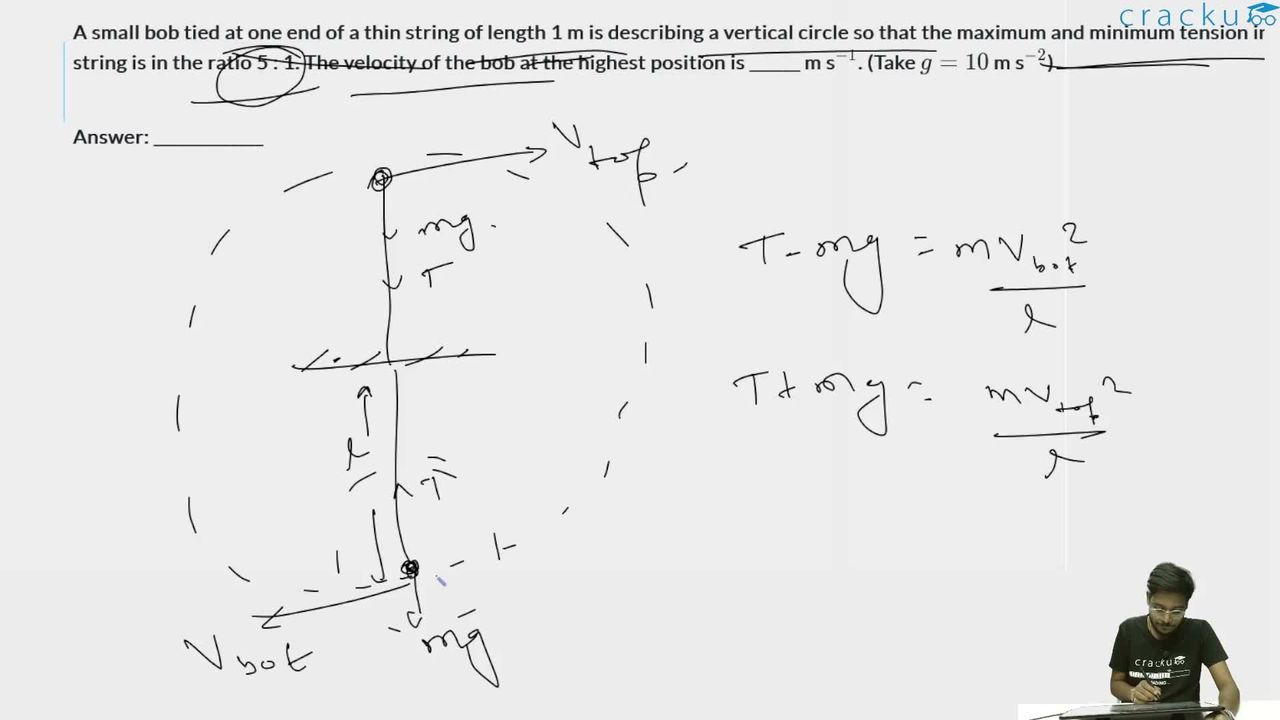
For a bob of mass $$m$$ tied to a string of length $$L = 1$$ m describing a vertical circle, the tension at any point depends on the speed and the component of gravity along the string.
At the lowest point, the tension is maximum: $$T_{max} = \frac{mv_{bot}^2}{L} + mg$$.
At the highest point, the tension is minimum: $$T_{min} = \frac{mv_{top}^2}{L} - mg$$.
Using energy conservation between the top and bottom of the circle (height difference $$= 2L$$):
$$\frac{1}{2}mv_{bot}^2 = \frac{1}{2}mv_{top}^2 + mg(2L)$$
$$v_{bot}^2 = v_{top}^2 + 4gL$$
Given $$\frac{T_{max}}{T_{min}} = 5$$:
$$\frac{\frac{mv_{bot}^2}{L} + mg}{\frac{mv_{top}^2}{L} - mg} = 5$$
$$\frac{v_{bot}^2 + gL}{v_{top}^2 - gL} = 5$$
Substituting $$v_{bot}^2 = v_{top}^2 + 4gL$$:
$$\frac{v_{top}^2 + 4gL + gL}{v_{top}^2 - gL} = 5$$
$$v_{top}^2 + 5gL = 5v_{top}^2 - 5gL$$
$$10gL = 4v_{top}^2$$
$$v_{top}^2 = \frac{10 \times 10 \times 1}{4} = 25$$
$$v_{top} = 5$$ m s$$^{-1}$$
The velocity of the bob at the highest position is $$5$$ m s$$^{-1}$$.
Was this solution helpful?
Click on the Email ☝️ to Watch the Video Solution
Create a FREE account and get:
_1.webp)

Educational materials for JEE preparation

Ask our AI anything

AI can make mistakes. Please verify important information.
AI can make mistakes. Please verify important information.
