
Join Our JEE Preparation Group
Prep with like-minded aspirants; Get access to free daily tests and study material.
Sign in
Please select an account to continue using cracku.in
↓ →
Join Our JEE Preparation Group
Prep with like-minded aspirants; Get access to free daily tests and study material.
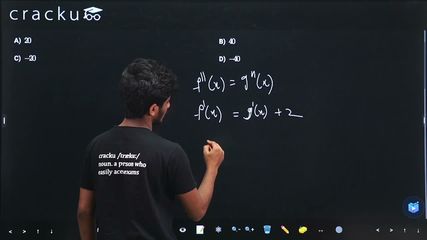
Let $$f(x)$$ and $$g(x)$$ be twice differentiable functions satisfying $$f''(x) = g''(x)$$ for all $$x$$, $$f'(1) = 2g'(1) = 4$$, and $$g(2) = 3f(2) = 9$$. Then $$f(25) - g(25)$$ is equal to :
Let us define a new function $$h(x)$$ by
$$h(x)=f(x)-g(x)$$
Given $$f''(x)=g''(x)$$ for all $$x$$, we have
$$h''(x)=f''(x)-g''(x)=0 \;\text{for all }x$$
If the second derivative of a function is zero everywhere, the function must be a polynomial of degree at most one. Hence
$$h(x)=ax+b \quad\text{for some constants }a,b$$
Step 1: Find $$a$$ using the derivative condition.
The derivative is $$h'(x)=a$$, so
$$h'(1)=a$$
The data give $$f'(1)=4$$ and $$g'(1)=2$$ (because $$f'(1)=2g'(1)=4 \Rightarrow g'(1)=2$$). Hence
$$h'(1)=f'(1)-g'(1)=4-2=2$$
Therefore, $$a=2$$.
Step 2: Find $$b$$ using the value condition.
The values at $$x=2$$ are $$g(2)=9$$ and $$f(2)=3$$ (since $$3f(2)=9\Rightarrow f(2)=3$$). Thus
$$h(2)=f(2)-g(2)=3-9=-6$$
But $$h(2)=a\cdot2+b=2\cdot2+b=4+b$$, so
$$4+b=-6\;\Longrightarrow\;b=-10$$
Step 3: Evaluate $$h(25)=f(25)-g(25)$$.
Now $$h(x)=2x-10$$, hence
$$h(25)=2\cdot25-10=50-10=40$$
Thus, $$f(25)-g(25)=40$$.
Option B which is: $$40$$
Was this solution helpful?
Click on the Email ☝️ to Watch the Video Solution
Create a FREE account and get:
_1.webp)

Educational materials for JEE preparation

Ask our AI anything

AI can make mistakes. Please verify important information.
AI can make mistakes. Please verify important information.
