
Join Our JEE Preparation Group
Prep with like-minded aspirants; Get access to free daily tests and study material.
Sign in
Please select an account to continue using cracku.in
↓ →
Join Our JEE Preparation Group
Prep with like-minded aspirants; Get access to free daily tests and study material.
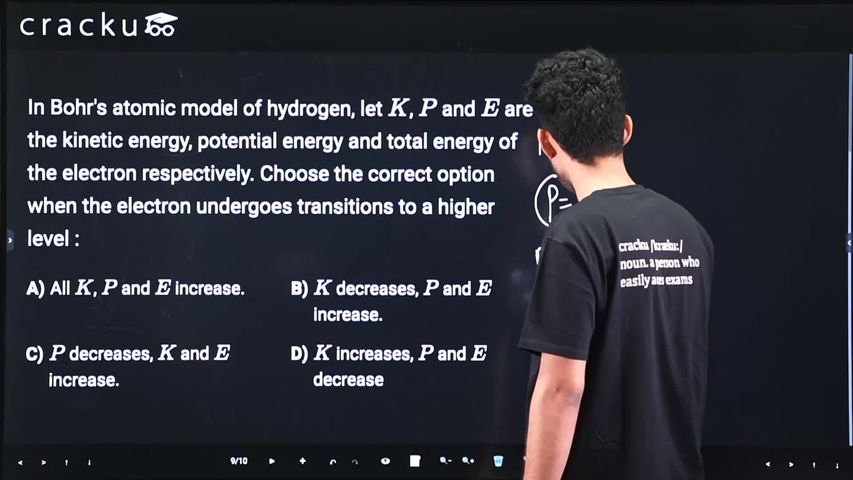
In Bohr's atomic model of hydrogen, let $$K$$, $$P$$ and $$E$$ are the kinetic energy, potential energy and total energy of the electron respectively. Choose the correct option when the electron undergoes transitions to a higher level :
We begin by recalling the energy expressions in Bohr’s model for the $$n$$-th orbit. The kinetic energy is given by:
$$K_n = \frac{13.6}{n^2} \text{ eV}$$
while the potential energy is
$$P_n = -\frac{27.2}{n^2} \text{ eV}$$
and the total energy is
$$E_n = -\frac{13.6}{n^2} \text{ eV}$$
Note that $$K_n$$ is always positive, $$P_n$$ is always negative, and $$E_n = K_n + P_n$$ remains negative.
Since the electron transitions to a higher energy level, $$n$$ increases and consequently $$n^2$$ increases. Substituting this into the kinetic energy expression,
$$K_n = \frac{13.6}{n^2}$$
we see that as $$n$$ increases, the denominator grows and the positive value of $$K_n$$ decreases.
Similarly, for the potential energy
$$P_n = -\frac{27.2}{n^2}$$
the magnitude $$\frac{27.2}{n^2}$$ becomes smaller, so $$P_n$$ becomes less negative and therefore increases (moves closer to zero).
For the total energy
$$E_n = -\frac{13.6}{n^2}$$
the same reduction in magnitude makes $$E_n$$ less negative, meaning that $$E_n$$ also increases (moves closer to zero).
From the above, when the electron moves to a higher level, the kinetic energy decreases, the potential energy increases, and the total energy increases. Therefore, the correct option is Option B.
Was this solution helpful?
Click on the Email ☝️ to Watch the Video Solution
Create a FREE account and get:
_1.webp)

Educational materials for JEE preparation

Ask our AI anything

AI can make mistakes. Please verify important information.
AI can make mistakes. Please verify important information.
