
Join Our JEE Preparation Group
Prep with like-minded aspirants; Get access to free daily tests and study material.
Sign in
Please select an account to continue using cracku.in
↓ →
Join Our JEE Preparation Group
Prep with like-minded aspirants; Get access to free daily tests and study material.
A body is projected from the ground at an angle of $$45°$$ with the horizontal. Its velocity after $$2$$ s is $$20$$ m s$$^{-1}$$. The maximum height reached by the body during its motion is ______ m. (use $$g = 10$$ m s$$^{-2}$$)
Correct Answer: 20
A body is projected at $$45°$$ with the horizontal. After $$2$$ s, its velocity is $$20$$ m/s, and we need to find the maximum height reached, with $$g = 10$$ m/s$$^2$$.
Let the initial speed be $$u$$; since $$\theta = 45°$$, the horizontal and vertical components of the initial velocity are
$$u_x = u\cos 45° = \frac{u}{\sqrt{2}}$$
$$u_y = u\sin 45° = \frac{u}{\sqrt{2}}$$
At time $$t = 2$$ s, the horizontal component remains unchanged while the vertical component becomes
$$v_x = \frac{u}{\sqrt{2}}$$
$$v_y = \frac{u}{\sqrt{2}} - gt = \frac{u}{\sqrt{2}} - 10 \times 2 = \frac{u}{\sqrt{2}} - 20$$
Since the resultant speed at $$t = 2$$ s satisfies
$$v^2 = v_x^2 + v_y^2 = 400$$
$$\left(\frac{u}{\sqrt{2}}\right)^2 + \left(\frac{u}{\sqrt{2}} - 20\right)^2 = 400$$
$$\frac{u^2}{2} + \frac{u^2}{2} - 2 \times 20 \times \frac{u}{\sqrt{2}} + 400 = 400$$
$$u^2 - \frac{40u}{\sqrt{2}} + 400 = 400$$
$$u^2 - 20\sqrt{2} \cdot u = 0$$
$$u(u - 20\sqrt{2}) = 0$$
Since $$u \neq 0$$, it follows that $$u = 20\sqrt{2}$$ m/s.
Now the maximum height is given by
$$H = \frac{u^2 \sin^2\theta}{2g}$$
$$H = \frac{(20\sqrt{2})^2 \times \sin^2 45°}{2 \times 10}$$
$$H = \frac{800 \times \frac{1}{2}}{20} = \frac{400}{20} = 20 \text{ m}$$
The maximum height reached by the body is $$20$$ m.
Was this solution helpful?
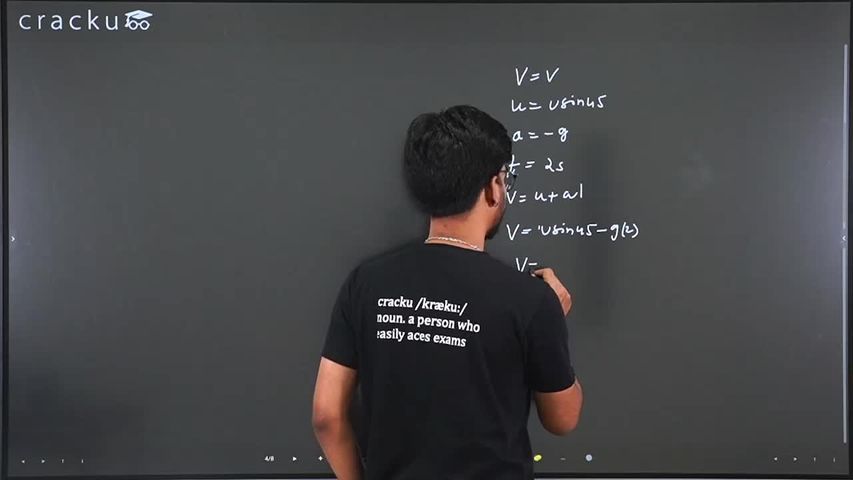
Click on the Email ☝️ to Watch the Video Solution
Create a FREE account and get:
_1.webp)

Educational materials for JEE preparation

Ask our AI anything

AI can make mistakes. Please verify important information.
AI can make mistakes. Please verify important information.
