
Join Our JEE Preparation Group
Prep with like-minded aspirants; Get access to free daily tests and study material.
Sign in
Please select an account to continue using cracku.in
↓ →
Join Our JEE Preparation Group
Prep with like-minded aspirants; Get access to free daily tests and study material.
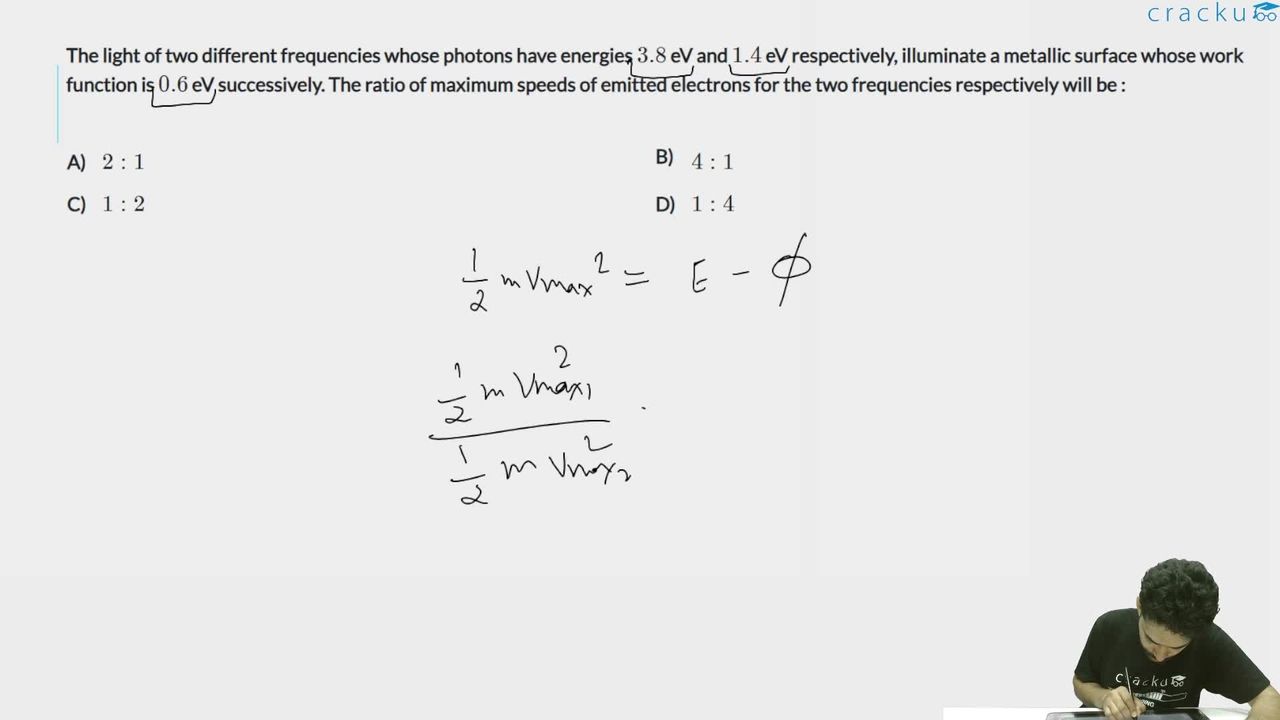
The light of two different frequencies whose photons have energies $$3.8$$ eV and $$1.4$$ eV respectively, illuminate a metallic surface whose work function is $$0.6$$ eV successively. The ratio of maximum speeds of emitted electrons for the two frequencies respectively will be :
We are given two photon energies $$E_1 = 3.8$$ eV and $$E_2 = 1.4$$ eV, and the work function $$\phi = 0.6$$ eV. We need to find the ratio of maximum speeds of emitted electrons.
By Einstein's photoelectric equation, the maximum kinetic energy is
$$\frac{1}{2}mv_{max}^2 = E_{photon} - \phi$$
For the first photon, substituting gives
$$KE_1 = E_1 - \phi = 3.8 - 0.6 = 3.2 \text{ eV}$$
Similarly, for the second photon,
$$KE_2 = E_2 - \phi = 1.4 - 0.6 = 0.8 \text{ eV}$$
Since kinetic energy is related to speed by $$KE = \frac{1}{2}mv^2$$, the ratio of squared speeds is
$$\frac{v_1^2}{v_2^2} = \frac{KE_1}{KE_2} = \frac{3.2}{0.8} = 4$$
Taking the square root, we find
$$\frac{v_1}{v_2} = \sqrt{4} = 2$$
From this, the ratio of maximum speeds is $$v_1 : v_2 = 2 : 1$$. Therefore, the correct option is Option A: $$2 : 1$$.
Was this solution helpful?
Click on the Email ☝️ to Watch the Video Solution
Create a FREE account and get:
_1.webp)

Educational materials for JEE preparation

Ask our AI anything

AI can make mistakes. Please verify important information.
AI can make mistakes. Please verify important information.
