
Join Our JEE Preparation Group
Prep with like-minded aspirants; Get access to free daily tests and study material.
Sign in
Please select an account to continue using cracku.in
↓ →
Join Our JEE Preparation Group
Prep with like-minded aspirants; Get access to free daily tests and study material.
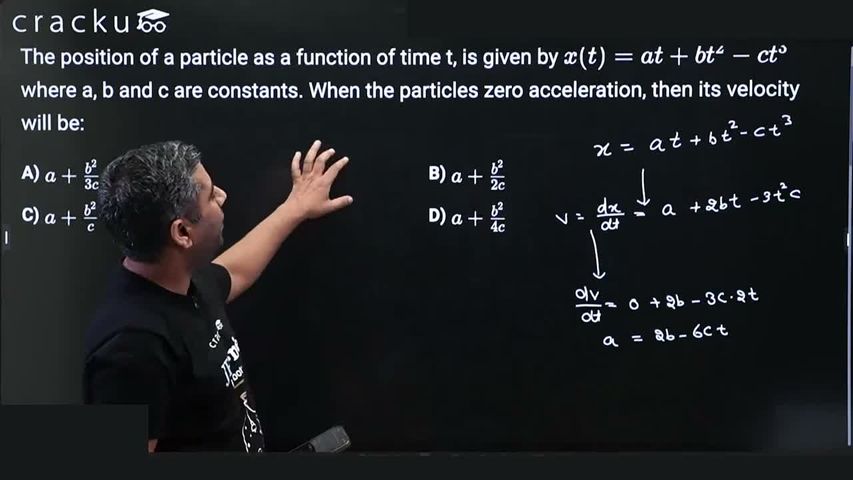
The position of a particle as a function of time t, is given by $$x(t) = at + bt^2 - ct^3$$ where a, b and c are constants. When the particles zero acceleration, then its velocity will be:
We have the displacement of the particle as a function of time, $$x(t)=at+bt^2-ct^3,$$ where the symbols $$a,\;b$$ and $$c$$ are constants.
The velocity is defined as the first derivative of displacement with respect to time, that is $$v(t)=\dfrac{dx}{dt}.$$ Differentiating term-by-term,
$$\begin{aligned} v(t) &= \dfrac{d}{dt}\!\bigl(at\bigr) + \dfrac{d}{dt}\!\bigl(bt^2\bigr) - \dfrac{d}{dt}\!\bigl(ct^3\bigr) \\ &= a + 2bt - 3ct^2. \end{aligned}$$
Acceleration is the derivative of velocity with respect to time, $$a(t)=\dfrac{dv}{dt}.$$ Differentiating the expression for $$v(t)$$ gives
$$\begin{aligned} a(t) &= \dfrac{d}{dt}\!\bigl(a\bigr) + \dfrac{d}{dt}\!\bigl(2bt\bigr) - \dfrac{d}{dt}\!\bigl(3ct^2\bigr) \\ &= 0 + 2b - 6ct \\ &= 2b - 6ct. \end{aligned}$$
The problem asks for the velocity when the acceleration becomes zero. So we set $$a(t)=0$$:
$$2b - 6ct = 0.$$
Solving for $$t$$ yields
$$\begin{aligned} 2b &= 6ct \\ t &= \frac{2b}{6c} \\ t &= \frac{b}{3c}. \end{aligned}$$
Now we substitute this value of $$t$$ back into the velocity expression $$v(t)=a+2bt-3ct^2$$ to find the required velocity:
$$\begin{aligned} v &= a + 2b\left(\frac{b}{3c}\right) - 3c\left(\frac{b}{3c}\right)^2 \\ &= a + \frac{2b^2}{3c} - 3c\left(\frac{b^2}{9c^2}\right) \\ &= a + \frac{2b^2}{3c} - \frac{b^2}{3c} \\ &= a + \frac{2b^2 - b^2}{3c} \\ &= a + \frac{b^2}{3c}. \end{aligned}$$
Hence, the velocity of the particle at the instant when its acceleration is zero is $$a + \dfrac{b^2}{3c}.$$
Hence, the correct answer is Option A.
Was this solution helpful?
Click on the Email ☝️ to Watch the Video Solution
Create a FREE account and get:
_1.webp)

Educational materials for JEE preparation

Ask our AI anything

AI can make mistakes. Please verify important information.
AI can make mistakes. Please verify important information.


