
Join Our JEE Preparation Group
Prep with like-minded aspirants; Get access to free daily tests and study material.
Sign in
Please select an account to continue using cracku.in
↓ →
Join Our JEE Preparation Group
Prep with like-minded aspirants; Get access to free daily tests and study material.
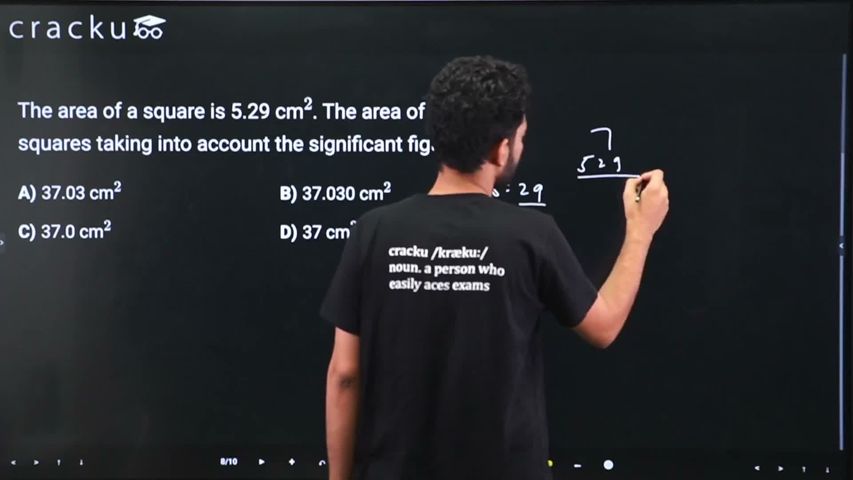
The area of a square is 5.29 cm$$^2$$. The area of 7 such squares taking into account the significant figures is:
We have the measured area of one square given as $$A_1 = 5.29\;\text{cm}^2$$.
The figure $$5.29$$ contains two digits after the decimal point, that is, it is known up to the hundredth of a square-centimetre. 7 is a pure counting number (we are simply counting seven identical squares), so it does not limit the precision. Therefore, when we multiply, we will keep our final result correct to the same number of decimal places—namely, two.
To obtain the total area of the seven squares we multiply:
$$A_{\text{total}} \;=\; 7 \times A_1$$
Substituting the value of $$A_1$$ we get
$$A_{\text{total}} \;=\; 7 \times 5.29\;\text{cm}^2$$
Now we perform the multiplication step by step:
$$$ \begin{aligned} 5.29 \times 7 &= (5 \times 7) + (0.29 \times 7) \\ &= 35 + 2.03 \\ &= 37.03 \end{aligned} $$$
So, before rounding we obtain
$$A_{\text{total}} = 37.03\;\text{cm}^2$$
The original measurement $$5.29$$ had two digits after the decimal point; hence we keep exactly two digits after the decimal point in the final answer. The figure $$37.03$$ already satisfies this requirement and therefore needs no further rounding.
Hence, the correct answer is Option A.
Was this solution helpful?
Click on the Email ☝️ to Watch the Video Solution
Create a FREE account and get:
_1.webp)

Educational materials for JEE preparation

Ask our AI anything

AI can make mistakes. Please verify important information.
AI can make mistakes. Please verify important information.


