
Join Our JEE Preparation Group
Prep with like-minded aspirants; Get access to free daily tests and study material.
Sign in
Please select an account to continue using cracku.in
↓ →
Join Our JEE Preparation Group
Prep with like-minded aspirants; Get access to free daily tests and study material.
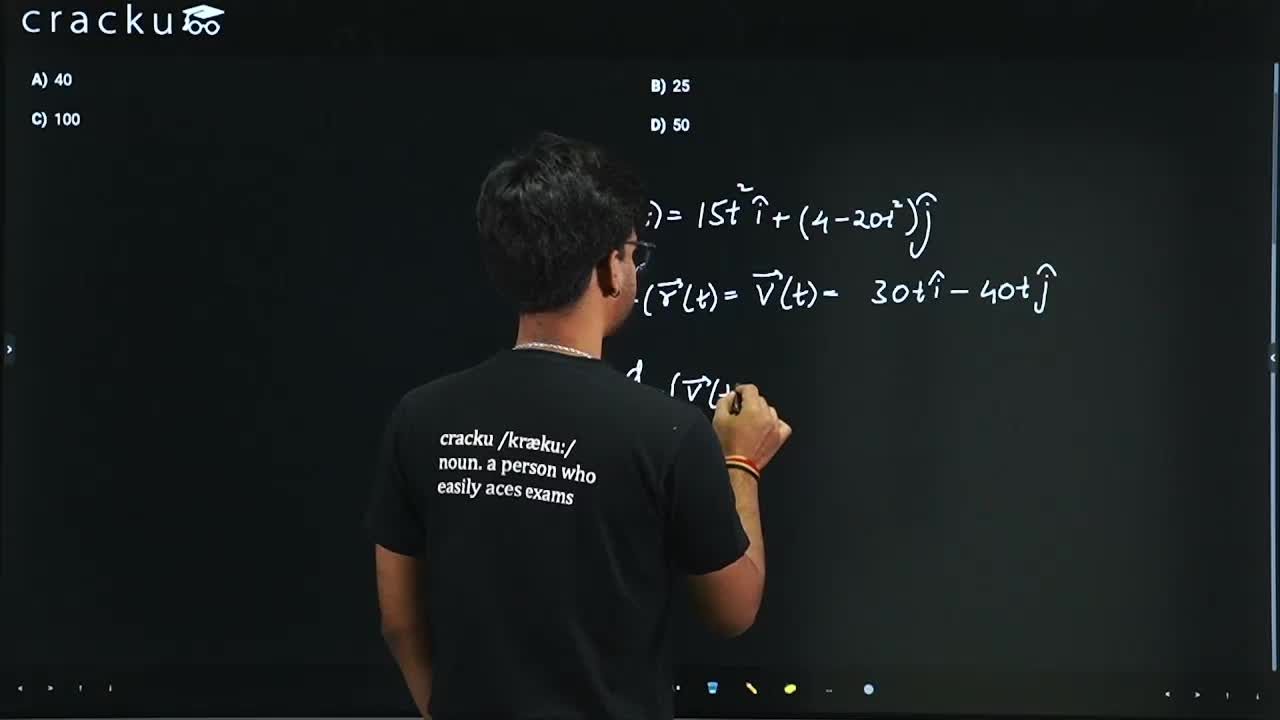
The position vector of a particle changes with time according to the relation $$\vec{r}(t) = 15t^2\hat{i} + (4 - 20t^2)\hat{j}$$. What is the magnitude of the acceleration at $$t = 1$$?
The position of the particle is given as $$\vec r(t)=15t^{2}\hat i+(4-20t^{2})\hat j$$.
To obtain the acceleration we must first find the velocity by differentiating the position with respect to time. We state the basic relation $$\vec v(t)=\dfrac{d\vec r}{dt}.$$
Differentiating each component separately, we get
$$\vec v(t)=\dfrac{d}{dt}\bigl(15t^{2}\bigr)\hat i+\dfrac{d}{dt}\bigl(4-20t^{2}\bigr)\hat j.$$
Performing the derivatives term-by-term, we have
$$\dfrac{d}{dt}(15t^{2}) = 30t,$$
$$\dfrac{d}{dt}(4) = 0,$$
$$\dfrac{d}{dt}(-20t^{2}) = -40t.$$
Substituting these results back, the velocity becomes
$$\vec v(t)=\bigl(30t\bigr)\hat i+\bigl(-40t\bigr)\hat j=30t\hat i-40t\hat j.$$
Acceleration is the time derivative of velocity, expressed by the formula $$\vec a(t)=\dfrac{d\vec v}{dt}.$$
Again differentiating component-wise, we write
$$\vec a(t)=\dfrac{d}{dt}\bigl(30t\bigr)\hat i+\dfrac{d}{dt}\bigl(-40t\bigr)\hat j.$$
The derivatives are straightforward:
$$\dfrac{d}{dt}(30t)=30,$$
$$\dfrac{d}{dt}(-40t)=-40.$$
Hence the acceleration vector is
$$\vec a(t)=30\hat i-40\hat j.$$
We now evaluate this vector at the required instant, $$t=1$$. Since the vector is already independent of $$t$$, we simply have
$$\vec a(1)=30\hat i-40\hat j.$$
The magnitude of a vector $$\vec a=a_{x}\hat i+a_{y}\hat j$$ is obtained using the Pythagorean formula $$|\vec a|=\sqrt{a_{x}^{2}+a_{y}^{2}}.$$ Substituting $$a_{x}=30$$ and $$a_{y}=-40$$ we get
$$|\vec a(1)|=\sqrt{(30)^{2}+(-40)^{2}}=\sqrt{900+1600}=\sqrt{2500}=50.$$
So the magnitude of the acceleration at $$t=1$$ is $$50$$.
Hence, the correct answer is Option D.
Was this solution helpful?
Click on the Email ☝️ to Watch the Video Solution
Create a FREE account and get:
_1.webp)

Educational materials for JEE preparation

Ask our AI anything

AI can make mistakes. Please verify important information.
AI can make mistakes. Please verify important information.


