
Join Our JEE Preparation Group
Prep with like-minded aspirants; Get access to free daily tests and study material.
Sign in
Please select an account to continue using cracku.in
↓ →
Join Our JEE Preparation Group
Prep with like-minded aspirants; Get access to free daily tests and study material.
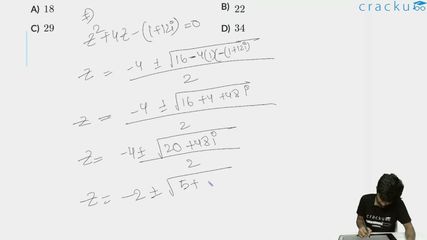
Let $$z_1, z_2 \in \mathbb{C}$$ be the distinct solutions of the equation $$z^2 + 4z - (1 + 12i) = 0$$. Then $$|z_1|^2 + |z_2|^2$$ is equal to :
For the quadratic$$z^{2}+4z-\left(1+12i\right)=0$$let the roots be $$z_{1},z_{2}\in\mathbb{C}$$.
Using the quadratic formula,
$$z_{1},z_{2}= \frac{-4\pm\sqrt{\,16+4(1+12i)\,}}{2}$$
Simplify the discriminant:
$$16+4(1+12i)=16+4+48i=20+48i=4(5+12i)$$
Hence
$$z_{1},z_{2}= \frac{-4\pm\sqrt{\,4(5+12i)\,}}{2} =\frac{-4\pm2\sqrt{\,5+12i\,}}{2} =-2\pm\sqrt{\,5+12i\,}$$
To proceed we need $$\sqrt{\,5+12i\,}$$. Let $$\sqrt{\,5+12i\,}=a+ib$$ with $$a,b\in\mathbb{R}$$. Then $$(a+ib)^{2}=a^{2}-b^{2}+2abi=5+12i$$ giving the system
$$a^{2}-b^{2}=5\quad\text{and}\quad2ab=12\;.$$
From $$2ab=12$$ we get $$ab=6\;,$$ so $$b=\dfrac{6}{a}\;.$$ Substituting in $$a^{2}-b^{2}=5$$:
$$a^{2}-\left(\dfrac{6}{a}\right)^{2}=5 \;\Longrightarrow\;a^{4}-5a^{2}-36=0$$
Put $$x=a^{2}$$ to obtain $$x^{2}-5x-36=0$$ whose positive root is
$$x=\frac{5+13}{2}=9\;\Longrightarrow\;a^{2}=9\;\Longrightarrow\;a=3$$ (we take the positive value for the principal square root).
Then $$b=\dfrac{6}{a}=2\;,$$ so
$$\sqrt{\,5+12i\,}=3+2i\;.$$
Therefore
$$z_{1}=-2+(3+2i)=1+2i,\qquad z_{2}=-2-(3+2i)=-5-2i$$
Now compute the required sum:
$$|z_{1}|^{2}=1^{2}+2^{2}=1+4=5,$$
$$|z_{2}|^{2}=(-5)^{2}+(-2)^{2}=25+4=29.$$
Hence
$$|z_{1}|^{2}+|z_{2}|^{2}=5+29=34.$$
Option D which is: $$34$$
Was this solution helpful?
Click on the Email ☝️ to Watch the Video Solution
Create a FREE account and get:
_1.webp)

Educational materials for JEE preparation

Ask our AI anything

AI can make mistakes. Please verify important information.
AI can make mistakes. Please verify important information.
