
Join Our JEE Preparation Group
Prep with like-minded aspirants; Get access to free daily tests and study material.
Sign in
Please select an account to continue using cracku.in
↓ →
Join Our JEE Preparation Group
Prep with like-minded aspirants; Get access to free daily tests and study material.
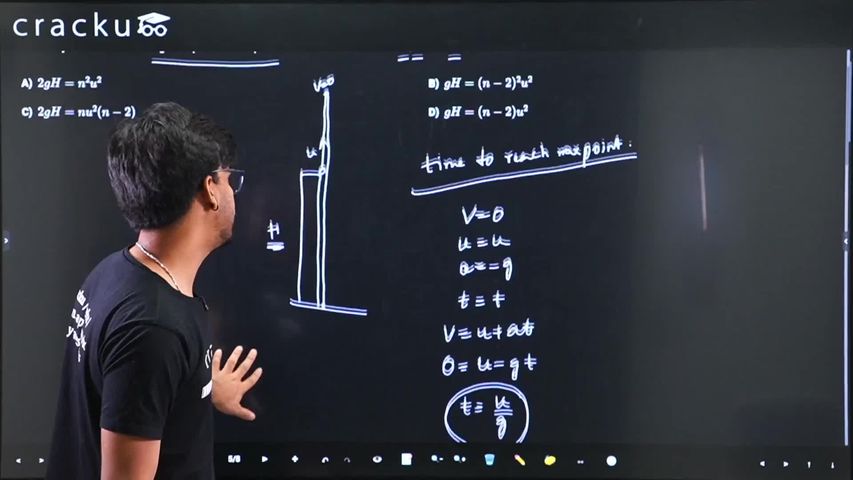
From a tower of height H, a particle is thrown vertically upwards with a speed u. The time taken by the particle, to hit the ground, is n times that taken by it to reach the highest point of its path. The relation between H, u and n is:
Let us call the time taken by the particle to reach the highest point of its flight $$t_1$$. At that highest point the velocity becomes zero. For motion under uniform retardation we have the first-equation of motion $$v = u + at$$. Here the final velocity is $$0$$, the initial velocity is $$u$$ and the acceleration is $$-g$$ (because gravity opposes the upward motion). Hence
$$0 = u - g t_1 \; \Longrightarrow \; t_1 = \frac{u}{g}.$$
During this upward journey the particle rises a vertical distance $$s_1$$ above the top of the tower. Using the second‐equation of motion
$$s = ut + \frac{1}{2} a t^{\,2},$$
with $$u \rightarrow u,\; t \rightarrow t_1,\; a \rightarrow -g$$ we obtain
$$s_1 = u t_1 - \frac{1}{2} g t_1^{\,2}.$$
Substituting $$t_1 = u/g$$ inside, we get
$$s_1 = u\left(\frac{u}{g}\right) - \frac{1}{2} g\left(\frac{u}{g}\right)^{\!2}
= \frac{u^{2}}{g} - \frac{1}{2}\frac{u^{2}}{g}
= \frac{u^{2}}{2g}.$$
The greatest vertical height of the particle above the ground is therefore
$$H_{\text{max}} = H + s_1 = H + \frac{u^{2}}{2g}.$$
From the highest point the particle starts its downward fall with zero initial velocity. Let the time of this fall be $$t_2$$. During this descent it covers a distance $$H + \dfrac{u^{2}}{2g}$$ under constant acceleration $$g$$. Again invoking the second‐equation of motion with $$u = 0,\; a = g,\; t = t_2$$, we have
$$H + \frac{u^{2}}{2g} = \frac{1}{2} g t_2^{\,2}.$$
Rearranging,
$$t_2^{\,2} = \frac{2}{g}\!\left(H + \frac{u^{2}}{2g}\right)
= \frac{2H}{g} + \frac{u^{2}}{g^{2}},$$
$$t_2 = \sqrt{\frac{2H}{g} + \frac{u^{2}}{g^{2}}}.$$
According to the statement of the problem the total time taken to hit the ground is $$n$$ times the time to reach the highest point. The total time is $$t_1 + t_2$$. Hence we can write
$$t_1 + t_2 = n\,t_1
\;\;\Longrightarrow\;\;
t_2 = (n-1)t_1.$$
We already have $$t_1 = \dfrac{u}{g}$$, so
$$t_2 = (n-1)\frac{u}{g}.$$
But we also have an explicit expression for $$t_2$$ obtained from the descent. Equating the two values of $$t_2$$,
$$(n-1)\frac{u}{g} = \sqrt{\frac{2H}{g} + \frac{u^{2}}{g^{2}}}.$$
Squaring both sides to eliminate the square root,
$$(n-1)^{2}\frac{u^{2}}{g^{2}} = \frac{2H}{g} + \frac{u^{2}}{g^{2}}.$$
Multiplying every term by $$g^{2}$$ gives
$$(n-1)^{2}u^{2} = 2Hg + u^{2}.$$
Now let us bring the $$u^{2}$$ term on the left next to the existing $$u^{2}$$ factor:
$$(n-1)^{2}u^{2} - u^{2} = 2Hg.$$
Taking $$u^{2}$$ common,
$$\big[(n-1)^{2} - 1\big]\,u^{2} = 2Hg.$$
Expanding and simplifying the bracket,
$$(n^{2} - 2n + 1) - 1 = n^{2} - 2n,$$
so that
$$\big[n^{2} - 2n\big]\,u^{2} = 2Hg.$$
Factoring $$n$$ out of the bracket,
$$n(n-2)\,u^{2} = 2Hg.$$
Finally writing the result in a compact symmetric form,
$$2gH = n u^{2}(n - 2).$$
This is exactly the relation given in Option C.
Hence, the correct answer is Option C.
Was this solution helpful?
Click on the Email ☝️ to Watch the Video Solution
Create a FREE account and get:
_1.webp)

Educational materials for JEE preparation

Ask our AI anything

AI can make mistakes. Please verify important information.
AI can make mistakes. Please verify important information.


