
Join Our JEE Preparation Group
Prep with like-minded aspirants; Get access to free daily tests and study material.
Sign in
Please select an account to continue using cracku.in
↓ →
Join Our JEE Preparation Group
Prep with like-minded aspirants; Get access to free daily tests and study material.
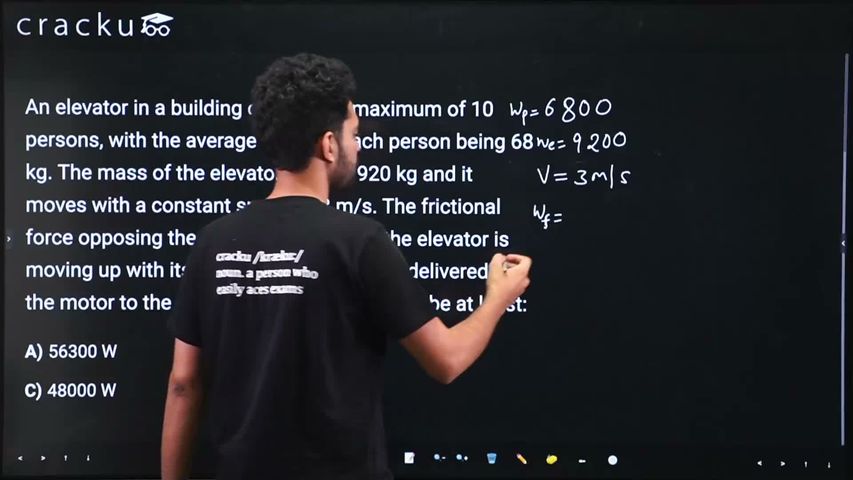
An elevator in a building can carry a maximum of 10 persons, with the average mass of each person being 68 kg. The mass of the elevator itself is 920 kg and it moves with a constant speed of 3 m/s. The frictional force opposing the motion is 6000 N. If the elevator is moving up with its full capacity, the power delivered by the motor to the elevator (g = 10 m/s$$^2$$) must be at least:
We begin by noting that the motor has to do two kinds of work while the elevator moves upward with uniform speed:
1. It must balance the gravitational pull on the combined mass of the elevator and all the passengers.
2. It must overcome the constant frictional force that opposes the motion.
The useful relation to find the power of the motor is the mechanical power formula
$$P = F \, v$$
where $$P$$ is the power delivered, $$F$$ is the total force that the motor must supply, and $$v$$ is the constant speed of the elevator.
Now we calculate each quantity step by step.
Step 1: Mass of passengers.
The problem states that the elevator is carrying its full capacity of 10 persons, each of average mass 68 kg. Hence
$$m_{\text{persons}} = 10 \times 68 \text{ kg} = 680 \text{ kg}.$$
Step 2: Mass of the empty elevator.
This is given directly as
$$m_{\text{elevator}} = 920 \text{ kg}.$$
Step 3: Total mass being lifted.
Adding the two masses, we obtain
$$m_{\text{total}} = m_{\text{persons}} + m_{\text{elevator}} = 680 \text{ kg} + 920 \text{ kg} = 1600 \text{ kg}.$$
Step 4: Gravitational force on this mass.
Using the standard relation $$\text{Weight} = m g$$ with $$g = 10 \text{ m/s}^2$$, we get
$$F_{\text{gravity}} = m_{\text{total}} \, g = 1600 \text{ kg} \times 10 \text{ m/s}^2 = 16000 \text{ N}.$$
Step 5: Frictional force.
The friction opposing the upward motion is specified as
$$F_{\text{friction}} = 6000 \text{ N}.$$
Step 6: Total opposing force.
Since the motor must counter both gravity and friction simultaneously, we add the two forces:
$$F_{\text{total}} = F_{\text{gravity}} + F_{\text{friction}} = 16000 \text{ N} + 6000 \text{ N} = 22000 \text{ N}.$$
Step 7: Constant speed of the elevator.
The elevator moves upward at
$$v = 3 \text{ m/s}.$$
Step 8: Required power of the motor.
Substituting $$F_{\text{total}}$$ and $$v$$ into $$P = F v$$, we obtain
$$ P = F_{\text{total}} \times v = 22000 \text{ N} \times 3 \text{ m/s} = 66000 \text{ W}. $$
Thus, the motor must supply at least $$66\,000 \text{ watts}$$ of power while lifting the fully-loaded elevator at the stated speed.
Hence, the correct answer is Option D.
Was this solution helpful?
Click on the Email ☝️ to Watch the Video Solution
Create a FREE account and get:
_1.webp)

Educational materials for JEE preparation

Ask our AI anything

AI can make mistakes. Please verify important information.
AI can make mistakes. Please verify important information.
