
Join Our JEE Preparation Group
Prep with like-minded aspirants; Get access to free daily tests and study material.
Sign in
Please select an account to continue using cracku.in
↓ →
Join Our JEE Preparation Group
Prep with like-minded aspirants; Get access to free daily tests and study material.
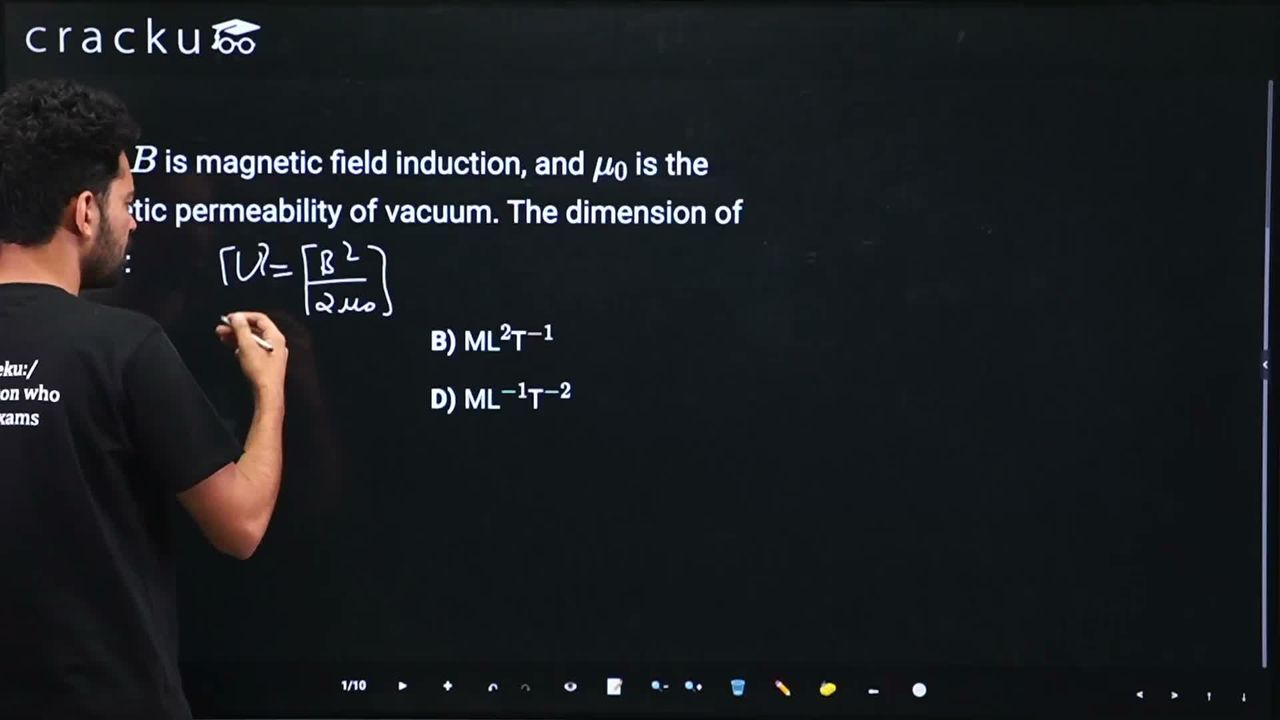
Given, $$B$$ is magnetic field induction, and $$\mu_0$$ is the magnetic permeability of vacuum. The dimension of $$\frac{B^2}{2\mu_0}$$ is:
We wish to evaluate the dimensional formula of the expression $$\dfrac{B^{2}}{2\mu_{0}}$$. The numerical factor $$2$$ is dimensionless, so the task reduces to finding the dimensions of $$\dfrac{B^{2}}{\mu_{0}}$$.
We begin with the magnetic induction $$B$$. By definition, the magnetic force on a straight conductor of length $$l$$ carrying current $$I$$ in a magnetic field $$B$$ is given by the formula
$$F = B\,I\,l\,\sin\theta.$$
Taking the maximum case $$\sin\theta = 1$$, we have $$B = \dfrac{F}{I\,l}$$. We now substitute the dimensional symbols:
$$[F] = M\,L\,T^{-2},\qquad [I] = I,\qquad [l] = L.$$
Hence
$$[B] \;=\; \dfrac{M\,L\,T^{-2}}{I\,L}\;=\;M\,T^{-2}\,I^{-1}.$$
Next we consider the magnetic permeability of free space $$\mu_{0}$$. It is related to $$B$$ and the magnetic field strength $$H$$ by the relation $$B = \mu_{0}H$$. The field strength $$H$$ is defined as current per unit length, so
$$[H] \;=\; \dfrac{I}{L} \;=\; I\,L^{-1}.$$
Therefore,
$$[\mu_{0}] \;=\; \dfrac{[B]}{[H]} \;=\; \dfrac{M\,T^{-2}\,I^{-1}}{I\,L^{-1}} \;=\; M\,L\,T^{-2}\,I^{-2}.$$
We now square the dimension of $$B$$:
$$[B^{2}] \;=\; \bigl(M\,T^{-2}\,I^{-1}\bigr)^{2} \;=\; M^{2}\,T^{-4}\,I^{-2}.$$
Dividing this by $$[\mu_{0}]$$ gives
$$\left[\dfrac{B^{2}}{\mu_{0}}\right] \;=\; \dfrac{M^{2}\,T^{-4}\,I^{-2}}{M\,L\,T^{-2}\,I^{-2}} \;=\; M\,L^{-1}\,T^{-2}.$$
Thus the complete expression $$\dfrac{B^{2}}{2\mu_{0}}$$ has the same dimension, because the factor $$2$$ is dimensionless:
$$\left[\dfrac{B^{2}}{2\mu_{0}}\right] \;=\; M\,L^{-1}\,T^{-2}.$$
This corresponds to Option D.
Hence, the correct answer is Option D.
Was this solution helpful?
Click on the Email ☝️ to Watch the Video Solution
Create a FREE account and get:
_1.webp)

Educational materials for JEE preparation

Ask our AI anything

AI can make mistakes. Please verify important information.
AI can make mistakes. Please verify important information.
