
Join Our JEE Preparation Group
Prep with like-minded aspirants; Get access to free daily tests and study material.
Sign in
Please select an account to continue using cracku.in
↓ →
Join Our JEE Preparation Group
Prep with like-minded aspirants; Get access to free daily tests and study material.
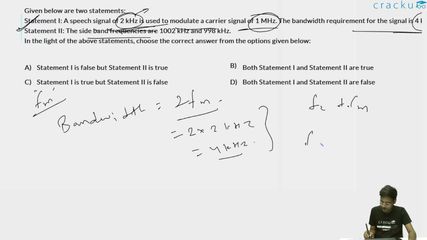
Given below are two statements:
Statement I: A speech signal of 2 kHz is used to modulate a carrier signal of 1 MHz. The bandwidth requirement for the signal is 4 kHz.
Statement II: The side band frequencies are 1002 kHz and 998 kHz.
In the light of the above statements, choose the correct answer from the options given below:
In amplitude modulation, when a signal of frequency $$f_m$$ modulates a carrier of frequency $$f_c$$, the resulting modulated wave contains three frequencies: the carrier frequency $$f_c$$, and two side band frequencies $$f_c + f_m$$ and $$f_c - f_m$$.
The bandwidth required is $$2f_m$$, which is the difference between the upper and lower side band frequencies.
Given $$f_m = 2$$ kHz and $$f_c = 1$$ MHz $$= 1000$$ kHz:
Statement I: The bandwidth requirement is $$2 \times 2 = 4$$ kHz. This is true.
Statement II: The upper side band frequency is $$f_c + f_m = 1000 + 2 = 1002$$ kHz, and the lower side band frequency is $$f_c - f_m = 1000 - 2 = 998$$ kHz. This is true.
Since both statements are correct, the answer is Option (2): Both Statement I and Statement II are true.
Was this solution helpful?
Click on the Email ☝️ to Watch the Video Solution
Create a FREE account and get:
_1.webp)

Educational materials for JEE preparation

Ask our AI anything

AI can make mistakes. Please verify important information.
AI can make mistakes. Please verify important information.
