
Join Our JEE Preparation Group
Prep with like-minded aspirants; Get access to free daily tests and study material.
Sign in
Please select an account to continue using cracku.in
↓ →
Join Our JEE Preparation Group
Prep with like-minded aspirants; Get access to free daily tests and study material.
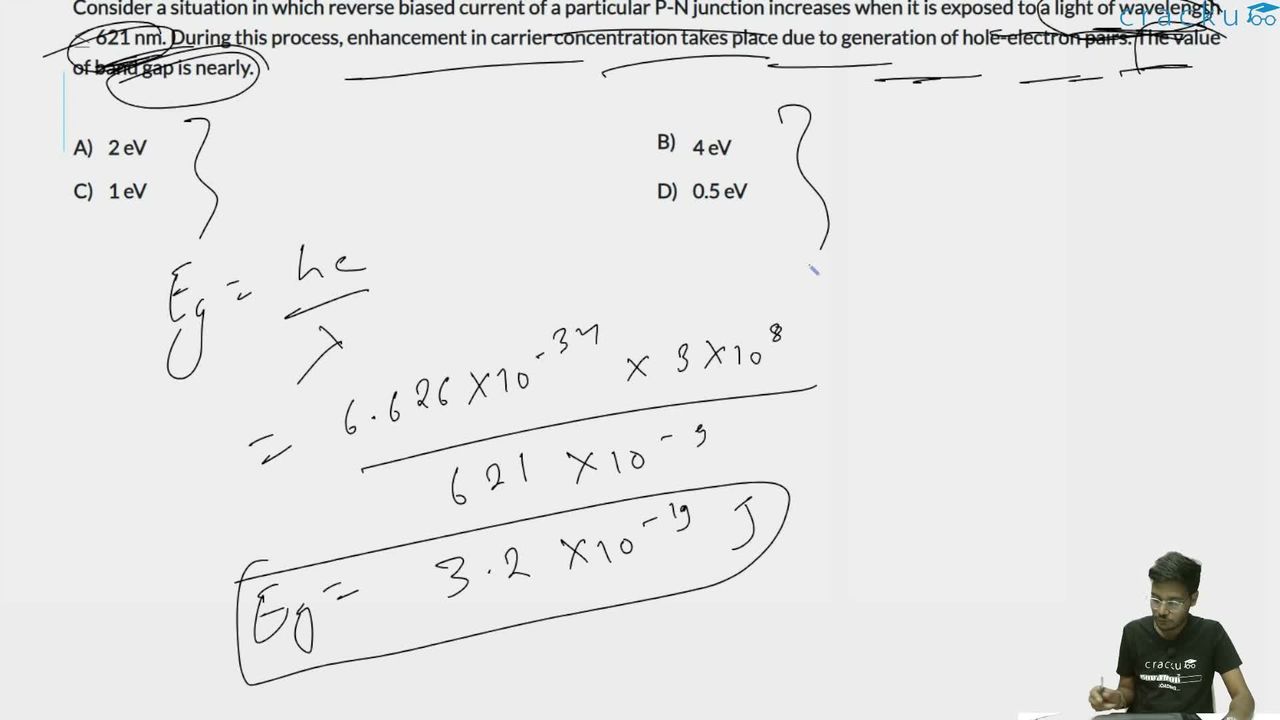
Consider a situation in which reverse biased current of a particular P-N junction increases when it is exposed to a light of wavelength $$\le$$ 621 nm. During this process, enhancement in carrier concentration takes place due to generation of hole-electron pairs. The value of band gap is nearly.
When light of wavelength $$\lambda \leq 621 \text{ nm}$$ falls on the reverse-biased P-N junction, it generates hole-electron pairs, increasing the reverse current. This means the photon energy must be at least equal to the band gap energy.
The minimum photon energy (at maximum wavelength $$\lambda = 621 \text{ nm}$$) equals the band gap: $$E_g = \frac{hc}{\lambda}$$
Using $$h = 6.626 \times 10^{-34} \text{ J s}$$, $$c = 3 \times 10^8 \text{ m s}^{-1}$$, and $$\lambda = 621 \times 10^{-9} \text{ m}$$: $$E_g = \frac{6.626 \times 10^{-34} \times 3 \times 10^8}{621 \times 10^{-9}}$$
$$E_g = \frac{1.988 \times 10^{-25}}{6.21 \times 10^{-7}} = 3.20 \times 10^{-19} \text{ J}$$
Converting to electron volts: $$E_g = \frac{3.20 \times 10^{-19}}{1.6 \times 10^{-19}} = 2.0 \text{ eV}$$
The band gap of the semiconductor is approximately $$2 \text{ eV}$$.
Was this solution helpful?
Click on the Email ☝️ to Watch the Video Solution
Create a FREE account and get:
_1.webp)

Educational materials for JEE preparation

Ask our AI anything

AI can make mistakes. Please verify important information.
AI can make mistakes. Please verify important information.
