
Join Our JEE Preparation Group
Prep with like-minded aspirants; Get access to free daily tests and study material.
Sign in
Please select an account to continue using cracku.in
↓ →
Join Our JEE Preparation Group
Prep with like-minded aspirants; Get access to free daily tests and study material.
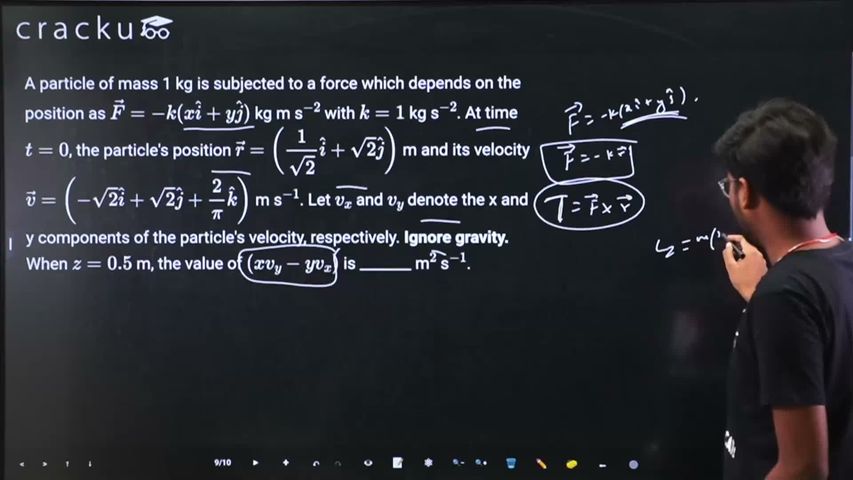
A particle of mass 1 kg is subjected to a force which depends on the position as $$\vec{F} = -k(x\hat{i} + y\hat{j})$$ kg m s$$^{-2}$$ with $$k = 1$$ kg s$$^{-2}$$. At time $$t = 0$$, the particle's position $$\vec{r} = \left(\dfrac{1}{\sqrt{2}}\hat{i} + \sqrt{2}\hat{j}\right)$$ m and its velocity $$\vec{v} = \left(-\sqrt{2}\hat{i} + \sqrt{2}\hat{j} + \dfrac{2}{\pi}\hat{k}\right)$$ m s$$^{-1}$$. Let $$v_x$$ and $$v_y$$ denote the x and y components of the particle's velocity, respectively. Ignore gravity. When $$z = 0.5$$ m, the value of $$(x v_y - y v_x)$$ is _______ m$$^2$$ s$$^{-1}$$.
Correct Answer: 3
The force acting on the particle is $$\vec{F}= -k\left(x\hat{i}+y\hat{j}\right)$$ with $$k=1$$ and the mass is $$m=1\;\text{kg}$$.
Hence the equations of motion in the $$x$$ and $$y$$ directions are
$$m\frac{d^2x}{dt^2}= -x,\qquad
m\frac{d^2y}{dt^2}= -y$$
or, since $$m=1$$,
$$\frac{d^2x}{dt^2}= -x,\qquad
\frac{d^2y}{dt^2}= -y.$$
Notice that the force always points along $$-\,(x\hat{i}+y\hat{j})$$, i.e. along the radius vector $$\vec{r}_{xy}=x\hat{i}+y\hat{j}$$ lying in the $$xy$$-plane. Therefore the torque about the origin is
$$\vec{\tau}= \vec{r}\times\vec{F}= (x\hat{i}+y\hat{j})\times\bigl(-(x\hat{i}+y\hat{j})\bigr)=\vec{0},$$
which implies that the angular momentum about the origin is conserved. The component of angular momentum along the $$z$$-axis is
$$L_z = (\vec{r}\times\vec{p})_z = x p_y - y p_x = m(xv_y - yv_x).$$
Because $$m=1\;\text{kg}$$, the conserved quantity simplifies to
$$xv_y - yv_x = \text{constant}.$$
Compute this constant using the initial data at $$t=0$$:
$$x_0 = \frac{1}{\sqrt{2}},\quad
y_0 = \sqrt{2},\quad
v_{x0} = -\sqrt{2},\quad
v_{y0} = \sqrt{2}.$$
$$\begin{aligned} x_0v_{y0} - y_0v_{x0} &= \left(\frac{1}{\sqrt{2}}\right)(\sqrt{2}) - (\sqrt{2})(-\sqrt{2}) \\ &= 1 - (-2) \\ &= 3\;\text{m}^2\text{s}^{-1}. \end{aligned}$$
The motion in the $$z$$-direction is unaffected by the force, so $$z(t) = z_0 + v_{z0}t$$. With $$z_0 = 0$$ and $$v_{z0}= \dfrac{2}{\pi}\;\text{m s}^{-1}$$, the condition $$z=0.5\;\text{m}$$ gives $$t = \dfrac{\pi}{4}\;\text{s}$$, but the conserved quantity $$xv_y - yv_x$$ remains the same at every instant.
Therefore, when $$z = 0.5\;\text{m}$$, the value of $$(xv_y - yv_x)$$ is still
$$3\;\text{m}^2\text{s}^{-1}.$$
Was this solution helpful?
Click on the Email ☝️ to Watch the Video Solution
Create a FREE account and get:
_1.webp)

Educational materials for JEE preparation

Ask our AI anything

AI can make mistakes. Please verify important information.
AI can make mistakes. Please verify important information.
