
Join Our JEE Preparation Group
Prep with like-minded aspirants; Get access to free daily tests and study material.
Sign in
Please select an account to continue using cracku.in
↓ →
Join Our JEE Preparation Group
Prep with like-minded aspirants; Get access to free daily tests and study material.
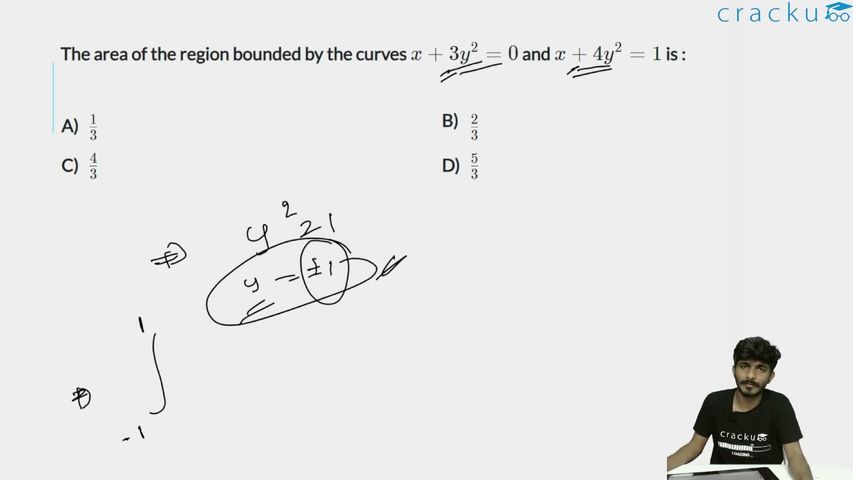
The area of the region bounded by the curves $$x + 3y^2 = 0$$ and $$x + 4y^2 = 1$$ is :
The two curves are given in the form $$x = f(y)$$, which is convenient for integrating with respect to $$y$$.
Curve 1 : $$x + 3y^{2} = 0 \;\Longrightarrow\; x = -3y^{2}$$
Curve 2 : $$x + 4y^{2} = 1 \;\Longrightarrow\; x = 1 - 4y^{2}$$
To enclose a bounded region, we need the $$y$$-coordinates where the curves intersect. Set their $$x$$-values equal:
$$-3y^{2} = 1 - 4y^{2}$$
$$\;\Longrightarrow\; (-3y^{2} + 4y^{2}) = 1$$
$$\;\Longrightarrow\; y^{2} = 1 \;\Longrightarrow\; y = \pm 1$$
Between $$y = -1$$ and $$y = 1$$, the right-hand curve (larger $$x$$) is $$x = 1 - 4y^{2}$$ and the left-hand curve is $$x = -3y^{2}$$. Hence the horizontal width of the strip at a general $$y$$ is
$$x_{\text{right}} - x_{\text{left}} = \bigl(1 - 4y^{2}\bigr) - \bigl(-3y^{2}\bigr) = 1 - 4y^{2} + 3y^{2} = 1 - y^{2}$$
The required area is therefore
$$A = \int_{y=-1}^{1} \bigl(1 - y^{2}\bigr)\,dy$$
Integrate term by term:
$$\int 1\,dy = y$$, $$\int y^{2}\,dy = \frac{y^{3}}{3}$$
Thus
$$A = \Bigl[\,y - \frac{y^{3}}{3}\Bigr]_{-1}^{1}$$
Evaluate at the limits:
At $$y = 1$$: $$1 - \frac{1}{3} = \frac{2}{3}$$
At $$y = -1$$: $$(-1) - \bigl(-\frac{1}{3}\bigr) = -1 + \frac{1}{3} = -\frac{2}{3}$$
Subtracting:
$$A = \frac{2}{3} - \bigl(-\frac{2}{3}\bigr) = \frac{4}{3}$$
Hence, the bounded area equals $$\frac{4}{3}$$.
Option C which is: $$\frac{4}{3}$$
Click on the Email ☝️ to Watch the Video Solution
Create a FREE account and get:
_1.webp)

Educational materials for JEE preparation

Ask our AI anything

AI can make mistakes. Please verify important information.
AI can make mistakes. Please verify important information.


