
Join Our JEE Preparation Group
Prep with like-minded aspirants; Get access to free daily tests and study material.
Sign in
Please select an account to continue using cracku.in
↓ →
Join Our JEE Preparation Group
Prep with like-minded aspirants; Get access to free daily tests and study material.
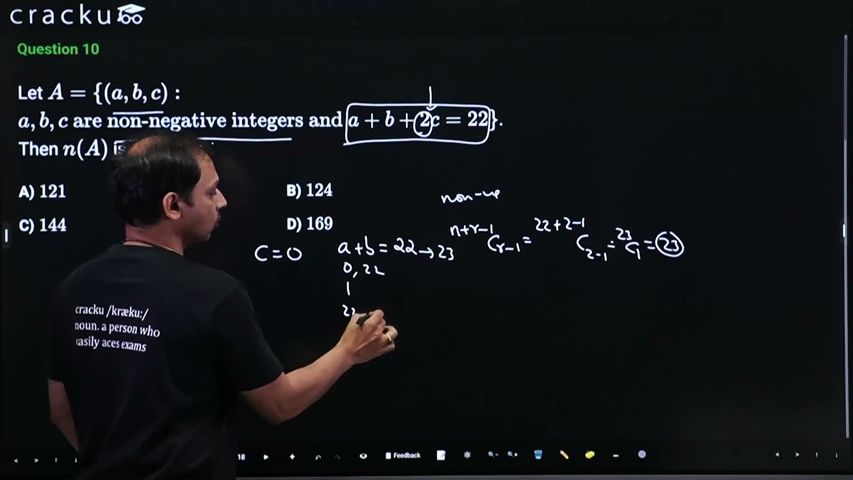
Let $$A = \{(a, b, c) : a, b, c \text{ are non-negative integers and } a + b + 2c = 22\}$$. Then $$n(A)$$ is equal to :
We need to find the number of ordered triples $$(a,b,c)$$ of non-negative integers that satisfy $$a+b+2c = 22$$.
Step 1: Fix $$c$$ and count $$(a,b)$$.
Because $$2c \le 22$$, the integer $$c$$ can take every value from $$0$$ to $$11$$ inclusive.
For a fixed $$c$$, rewrite the equation as $$a+b = 22-2c.$$ Let $$S = 22-2c$$. Here $$S$$ is a non-negative integer.
Step 2: Count non-negative solutions of $$a+b=S$$.
For any non-negative integer $$S$$, the number of ordered pairs $$(a,b)$$ with $$a+b=S$$ is $$S+1$$ (by the “stars and bars” formula or by listing $$a=0,1,\dots,S$$).
Step 3: Sum over all possible values of $$c$$.
Hence the required count is $$n(A)=\sum_{c=0}^{11}\bigl[(22-2c)+1\bigr] =\sum_{c=0}^{11}(23-2c).$$
Step 4: Evaluate the arithmetic series.
The series $$23-2c$$ is an arithmetic progression with first term $$23$$ and last term $$23-2\cdot11=1$$. There are $$11-0+1 = 12$$ terms.
Sum of an AP = $$\dfrac{\text{number of terms}}{2}\times(\text{first term}+\text{last term})$$, so $$n(A)=\dfrac{12}{2}\times(23+1)=6\times24=144.$$
Step 5: State the answer.
Therefore, $$n(A)=144$$.
Option C which is: $$144$$
Was this solution helpful?
Click on the Email ☝️ to Watch the Video Solution
Create a FREE account and get:
Educational materials for JEE preparation

Ask our AI anything

AI can make mistakes. Please verify important information.
AI can make mistakes. Please verify important information.

_1.webp)
