
Join Our JEE Preparation Group
Prep with like-minded aspirants; Get access to free daily tests and study material.
Sign in
Please select an account to continue using cracku.in
↓ →
Join Our JEE Preparation Group
Prep with like-minded aspirants; Get access to free daily tests and study material.
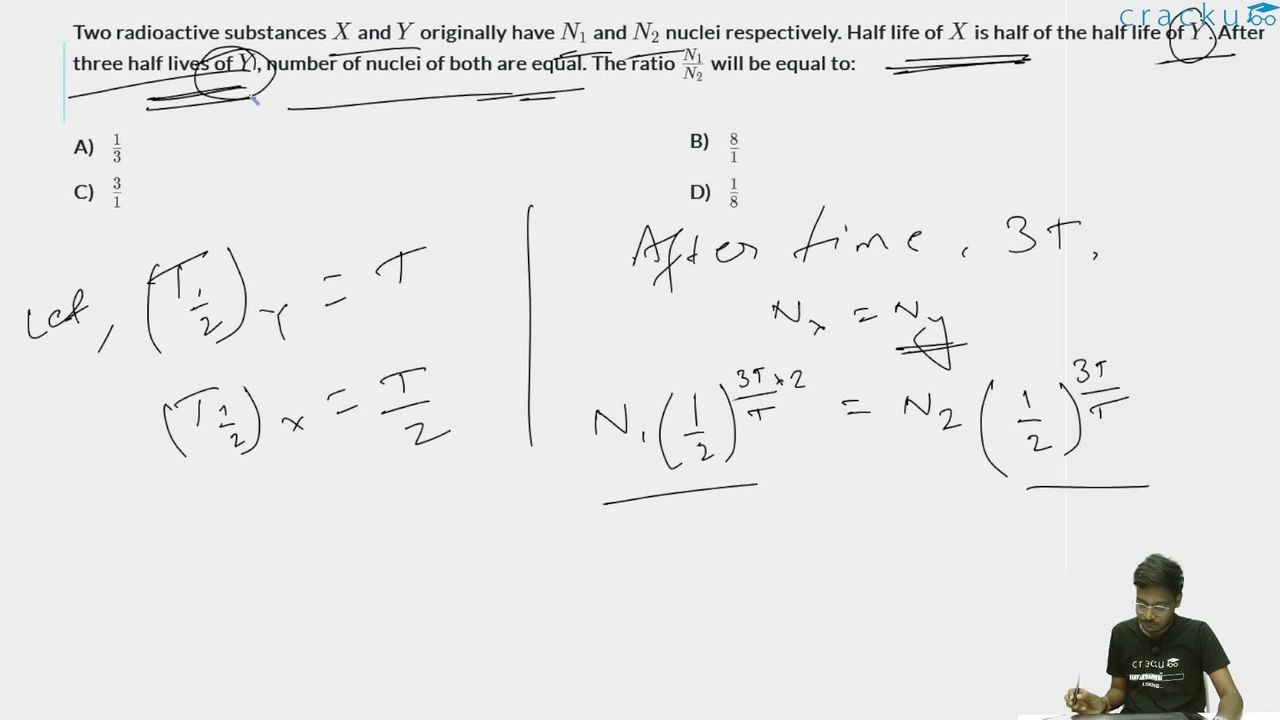
Two radioactive substances $$X$$ and $$Y$$ originally have $$N_1$$ and $$N_2$$ nuclei respectively. Half life of $$X$$ is half of the half life of $$Y$$. After three half lives of $$Y$$, number of nuclei of both are equal. The ratio $$\frac{N_1}{N_2}$$ will be equal to:
Let the half-life of substance $$Y$$ be $$T$$. Then the half-life of substance $$X$$ is $$\frac{T}{2}$$ (since it is half of the half-life of $$Y$$).
After three half-lives of $$Y$$, the elapsed time is $$3T$$. During this time, substance $$X$$ undergoes $$\frac{3T}{T/2} = 6$$ half-lives, and substance $$Y$$ undergoes $$3$$ half-lives.
The number of nuclei remaining for $$X$$ is $$\frac{N_1}{2^6} = \frac{N_1}{64}$$, and for $$Y$$ is $$\frac{N_2}{2^3} = \frac{N_2}{8}$$.
Setting these equal as given in the problem:
$$\frac{N_1}{64} = \frac{N_2}{8}$$
$$\frac{N_1}{N_2} = \frac{64}{8} = 8$$
The correct answer is Option (2): $$\frac{8}{1}$$.
Was this solution helpful?
Click on the Email ☝️ to Watch the Video Solution
Create a FREE account and get:
_1.webp)

Educational materials for JEE preparation

Ask our AI anything

AI can make mistakes. Please verify important information.
AI can make mistakes. Please verify important information.
