
Join Our JEE Preparation Group
Prep with like-minded aspirants; Get access to free daily tests and study material.
Sign in
Please select an account to continue using cracku.in
↓ →
Join Our JEE Preparation Group
Prep with like-minded aspirants; Get access to free daily tests and study material.
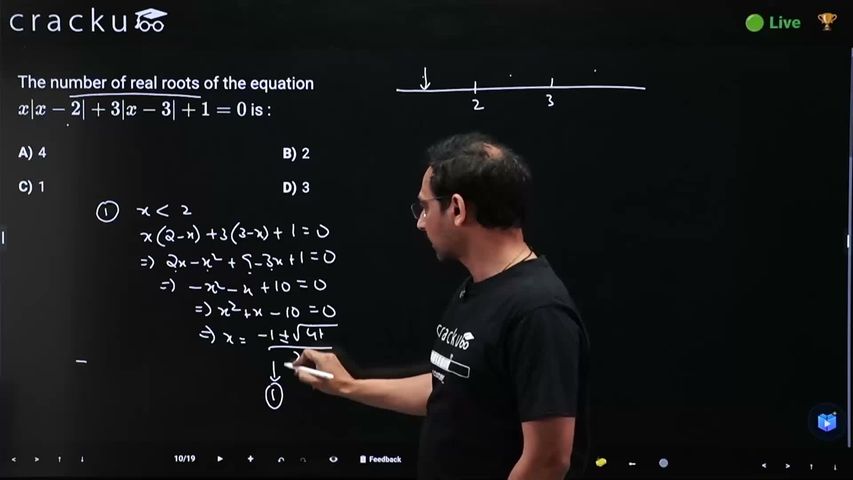
First split the real line at the points where the absolute-value expressions change their form, i.e. at $$x = 2$$ and $$x = 3$$. This gives three disjoint intervals:
Case 1:
$$x \lt 2$$ Here $$|x-2| = 2-x$$ and $$|x-3| = 3-x$$.
The equation becomes $$x(2-x) + 3(3-x) + 1 = 0$$ $$\Rightarrow 2x - x^{2} + 9 - 3x + 1 = 0$$ $$\Rightarrow -x^{2} - x + 10 = 0$$ $$\Rightarrow x^{2} + x - 10 = 0$$ $$-(1)$$
Using the quadratic formula on $$(1)$$: $$x = \frac{-1 \pm \sqrt{1 + 40}}{2} = \frac{-1 \pm \sqrt{41}}{2}$$
Numerically, $$\dfrac{-1 - \sqrt{41}}{2} \approx -3.70$$ and $$\dfrac{-1 + \sqrt{41}}{2} \approx 2.70$$. Only the first value satisfies $$x \lt 2$$. Hence Case 1 contributes exactly one real root: $$x = \dfrac{-1 - \sqrt{41}}{2}.$$
Case 2:
$$2 \le x \lt 3$$ Here $$|x-2| = x-2$$ and $$|x-3| = 3-x$$.
The equation becomes $$x(x-2) + 3(3-x) + 1 = 0$$ $$\Rightarrow x^{2} - 2x + 9 - 3x + 1 = 0$$ $$\Rightarrow x^{2} - 5x + 10 = 0$$ $$-(2)$$
For $$(2)$$, the discriminant is $$\Delta = (-5)^{2} - 4(1)(10) = 25 - 40 = -15 \lt 0,$$ so there are no real roots in Case 2.
Case 3:
$$x \ge 3$$ Here $$|x-2| = x-2$$ and $$|x-3| = x-3$$.
The equation becomes $$x(x-2) + 3(x-3) + 1 = 0$$ $$\Rightarrow x^{2} - 2x + 3x - 9 + 1 = 0$$ $$\Rightarrow x^{2} + x - 8 = 0$$ $$-(3)$$
For $$(3)$$, the roots are $$x = \frac{-1 \pm \sqrt{1 + 32}}{2} = \frac{-1 \pm \sqrt{33}}{2}.$$ The positive root is $$\dfrac{-1 + \sqrt{33}}{2} \approx 2.37,$$ which is less than $$3,$$ and the negative root is even smaller. Hence neither root lies in the interval $$x \ge 3,$$ so Case 3 contributes no real roots.
Combining all three cases, only one value of $$x$$ satisfies the given equation.
Therefore the total number of real roots is $$1$$, corresponding to Option C.
Click on the Email ☝️ to Watch the Video Solution
Create a FREE account and get:
_1.webp)

Educational materials for JEE preparation

Ask our AI anything

AI can make mistakes. Please verify important information.
AI can make mistakes. Please verify important information.


