
Join Our JEE Preparation Group
Prep with like-minded aspirants; Get access to free daily tests and study material.
Sign in
Please select an account to continue using cracku.in
↓ →
Join Our JEE Preparation Group
Prep with like-minded aspirants; Get access to free daily tests and study material.
Let $$f(x) = \displaystyle\lim_{y \to 0} \frac{(1 - \cos(xy))\tan(xy)}{y^3}$$. Then the number of solutions of the equation $$f(x) = \sin x$$, $$x \in \mathbb{R}$$, is :
We first evaluate $$f(x)$$.
Put $$t = xy \;\; \Rightarrow \;\; y = \frac{t}{x}$$.
As $$y \to 0$$, we have $$t \to 0$$ (for fixed $$x \neq 0$$). Then
$$\displaystyle f(x) = \lim_{y\to 0}\frac{(1-\cos(xy))\tan(xy)}{y^{3}} = x^{3}\,\lim_{t\to 0}\frac{(1-\cos t)\tan t}{t^{3}}.$$
To find the limit, expand the standard Taylor series about $$t=0$$:
$$1-\cos t = \frac{t^{2}}{2}-\frac{t^{4}}{24}+O(t^{6}),$$
$$\tan t = t+\frac{t^{3}}{3}+O(t^{5}).$$
Multiplying,
$$(1-\cos t)\tan t =\left(\frac{t^{2}}{2}\right)\!t+\left(\frac{t^{2}}{2}\right)\!\frac{t^{3}}{3} -\left(\frac{t^{4}}{24}\right)\!t + O(t^{7}) =\frac{t^{3}}{2}+\frac{t^{5}}{8}+O(t^{7}).$$
Hence
$$\frac{(1-\cos t)\tan t}{t^{3}} = \frac12 + \frac{t^{2}}{8}+O(t^{4}) \;\;\xrightarrow[t\to 0]{}\;\; \frac12.$$
Therefore
$$f(x)=\frac{x^{3}}{2}.$$
We now have to solve
$$\frac{x^{3}}{2}= \sin x,\qquad x\in\mathbb{R}.$$
Define $$g(x)=\sin x-\dfrac{x^{3}}{2}.$$ Both $$\sin x$$ and $$x^{3}/2$$ are odd functions, so if $$x_{0}$$ is a root, $$-x_{0}$$ is also a root. It is immediate that $$x=0$$ satisfies the equation.
Bounding the interval where roots can lie
Because $$|\sin x|\le 1,$$ a necessary condition for a solution is
$$\left|\dfrac{x^{3}}{2}\right|\le 1 \;\Longrightarrow\; |x|\le 2^{1/3}\approx 1.26.$$
Thus every real root lies in $$[-1.26,\,1.26].$$
Monotonicity of $$g(x)$$ on $$[0,1.26]$$
Compute the derivative:
$$g'(x)=\cos x-\frac{3x^{2}}{2}.$$
Set $$g'(x)=0: \;\cos x=\dfrac{3x^{2}}{2}.$$
For $$x\ge 1,$$ the right-hand side exceeds $$1,$$ while $$\cos x\le 1,$$ so no root
of $$g'(x)=0$$ exists beyond $$x=1.$$
Numerically, $$g'(x)$$ changes sign only once in $$[0,1]$$:
$$g'(0)=1>0,\quad g'(0.8)\approx 0.6967-0.96<0.$$
Hence $$g(x)$$ increases from $$x=0$$ up to some $$x=x_{m}<0.8,$$ attains a unique maximum, and then decreases on $$[x_{m},1.26].$$ Consequently, $$g(x)$$ can cross the $$x$$-axis at most once on the positive side.
Existence of one positive root
Evaluate $$g(x)$$ at two convenient points:
$$g(1)=\sin 1-\dfrac{1^{3}}{2}\approx 0.841-0.5=0.341>0,$$
$$g(1.3)=\sin 1.3-\dfrac{1.3^{3}}{2}\approx 0.964-1.099=-0.135<0.$$
By the Intermediate Value Theorem, $$g(x)=0$$ has exactly one root in $$(1,1.3).$$
Because $$g(x)$$ is odd, there is exactly one negative root, the reflection of the positive one, and we already have the root $$x=0.$$ Therefore the total number of real solutions is $$3.$$
Option C which is: 3
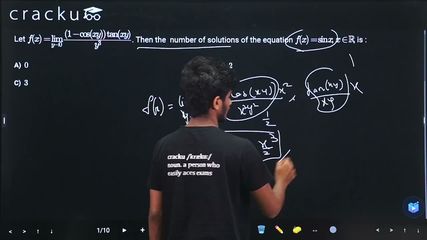
Click on the Email ☝️ to Watch the Video Solution
Create a FREE account and get:
_1.webp)

Educational materials for JEE preparation

Ask our AI anything

AI can make mistakes. Please verify important information.
AI can make mistakes. Please verify important information.


