
Join Our JEE Preparation Group
Prep with like-minded aspirants; Get access to free daily tests and study material.
Sign in
Please select an account to continue using cracku.in
↓ →
Join Our JEE Preparation Group
Prep with like-minded aspirants; Get access to free daily tests and study material.
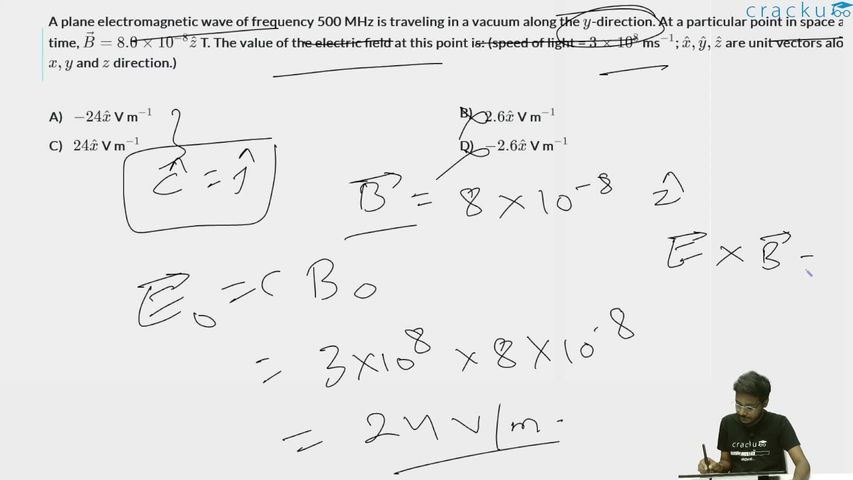
A plane electromagnetic wave of frequency 500 MHz is traveling in a vacuum along the $$y$$-direction. At a particular point in space and time, $$\vec{B} = 8.0 \times 10^{-8}\hat{z}$$ T. The value of the electric field at this point is: (speed of light = $$3 \times 10^{8}$$ ms$$^{-1}$$; $$\hat{x}, \hat{y}, \hat{z}$$ are unit vectors along $$x, y$$ and $$z$$ direction.)
An electromagnetic wave is travelling along the $$y$$-direction, and at a particular point $$\vec{B} = 8.0 \times 10^{-8} \, \hat{z}$$ T. We need to find the electric field $$\vec{E}$$.
The magnitude of the electric field is $$E = cB = 3 \times 10^8 \times 8.0 \times 10^{-8} = 24$$ V/m.
For the direction, the Poynting vector $$\vec{S} = \frac{1}{\mu_0} \vec{E} \times \vec{B}$$ must point in the direction of wave propagation, which is $$+\hat{y}$$. Since $$\vec{B}$$ is along $$+\hat{z}$$, we need $$\vec{E} \times \hat{z}$$ to be along $$+\hat{y}$$. Checking: $$(-\hat{x}) \times \hat{z} = -(\hat{x} \times \hat{z}) = -(-\hat{y}) = +\hat{y}$$. This works.
Therefore, $$\vec{E} = -24 \, \hat{x}$$ V m$$^{-1}$$.
Was this solution helpful?
Click on the Email ☝️ to Watch the Video Solution
Create a FREE account and get:
_1.webp)

Educational materials for JEE preparation

Ask our AI anything

AI can make mistakes. Please verify important information.
AI can make mistakes. Please verify important information.
