
Join Our JEE Preparation Group
Prep with like-minded aspirants; Get access to free daily tests and study material.
Sign in
Please select an account to continue using cracku.in
↓ →
Join Our JEE Preparation Group
Prep with like-minded aspirants; Get access to free daily tests and study material.
A parallel plate capacitor is made of two square plates of side $$a$$, separated by a distance $$d$$ ($$d \ll a$$). The lower triangular portion filled with a dielectric of dielectric constant $$K$$, as shown in the figure. Capacitance of this capacitor is:
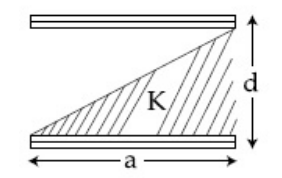
Consider a small element of width $$dx$$ at a distance $$x$$ from the left edge[cite: 1].
The total distance between the plates is $$d$$, and the side of the square plate is $$a$$[cite: 1].
The thickness of the dielectric medium at distance $$x$$ is given by:
$$$y = \frac{d}{a}x$$$
The remaining thickness of air/vacuum above the dielectric is:
$$$d - y = d - \frac{d}{a}x = d\left(1 - \frac{x}{a}\right)$$$
The elemental strip consists of two capacitors in series:
1. Air section of thickness $$d - y$$ with capacitance $$dC_1$$:
$$$dC_1 = \frac{\varepsilon_0 a\, dx}{d - y} = \frac{\varepsilon_0 a\, dx}{d\left(1 - \frac{x}{a}\right)}$$$
2. Dielectric section of thickness $$y$$ with dielectric constant $$K$$ and capacitance $$dC_2$$[cite: 1]:
$$$dC_2 = \frac{K \varepsilon_0 a\, dx}{y} = \frac{K \varepsilon_0 a\, dx}{\frac{d}{a}x}$$$
The equivalent capacitance $$dC$$ of this elemental section (in series) is:
$$$\frac{1}{dC} = \frac{1}{dC_1} + \frac{1}{dC_2}$$$
$$$\frac{1}{dC} = \frac{d\left(1 - \frac{x}{a}\right)}{\varepsilon_0 a\, dx} + \frac{\frac{d}{a}x}{K \varepsilon_0 a\, dx}$$$
$$$\frac{1}{dC} = \frac{d}{\varepsilon_0 a^2\, dx} \left[ a - x + \frac{x}{K} \right]$$$
$$$\frac{1}{dC} = \frac{d}{\varepsilon_0 a^2\, dx} \left[ a - x\left(1 - \frac{1}{K}\right) \right]$$$
Inverting to find $$dC$$:
$$$dC = \frac{\varepsilon_0 a^2\, dx}{d \left[ a - x\left(1 - \frac{1}{K}\right) \right]} = \frac{K \varepsilon_0 a^2\, dx}{d \left[ Ka - x(K - 1) \right]}$$$
To find the total capacitance $$C$$, integrate $$dC$$ from $$x = 0$$ to $$x = a$$:
$$$C = \int_0^a \frac{K \varepsilon_0 a^2}{d \left[ Ka - x(K - 1) \right]}\, dx$$$
Using the standard integral formula $\int \frac{dx}{A - Bx} = -\frac{1}{B} \ln|A - Bx|$:
$$$C = \frac{K \varepsilon_0 a^2}{d} \cdot \left[ -\frac{1}{K - 1} \ln\left| Ka - x(K - 1) \right| \right]_0^a$$$
$$$C = \frac{K \varepsilon_0 a^2}{d(K - 1)} \cdot \left[ \ln(Ka) - \ln\left( Ka - a(K - 1) \right) \right]$$$
$$$C = \frac{K \varepsilon_0 a^2}{d(K - 1)} \cdot \left[ \ln(Ka) - \ln(a) \right]$$$
$$$C = \frac{K \varepsilon_0 a^2}{d(K - 1)} \ln(K)$$$
Thus, the capacitance of the given capacitor is:
$$$C = \frac{K \varepsilon_0 a^2}{d(K - 1)} \ln K$$$
Was this solution helpful?
Create a FREE account and get:
_1.webp)

Educational materials for JEE preparation

Ask our AI anything

AI can make mistakes. Please verify important information.
AI can make mistakes. Please verify important information.
