
Join Our JEE Preparation Group
Prep with like-minded aspirants; Get access to free daily tests and study material.
Sign in
Please select an account to continue using cracku.in
↓ →
Join Our JEE Preparation Group
Prep with like-minded aspirants; Get access to free daily tests and study material.
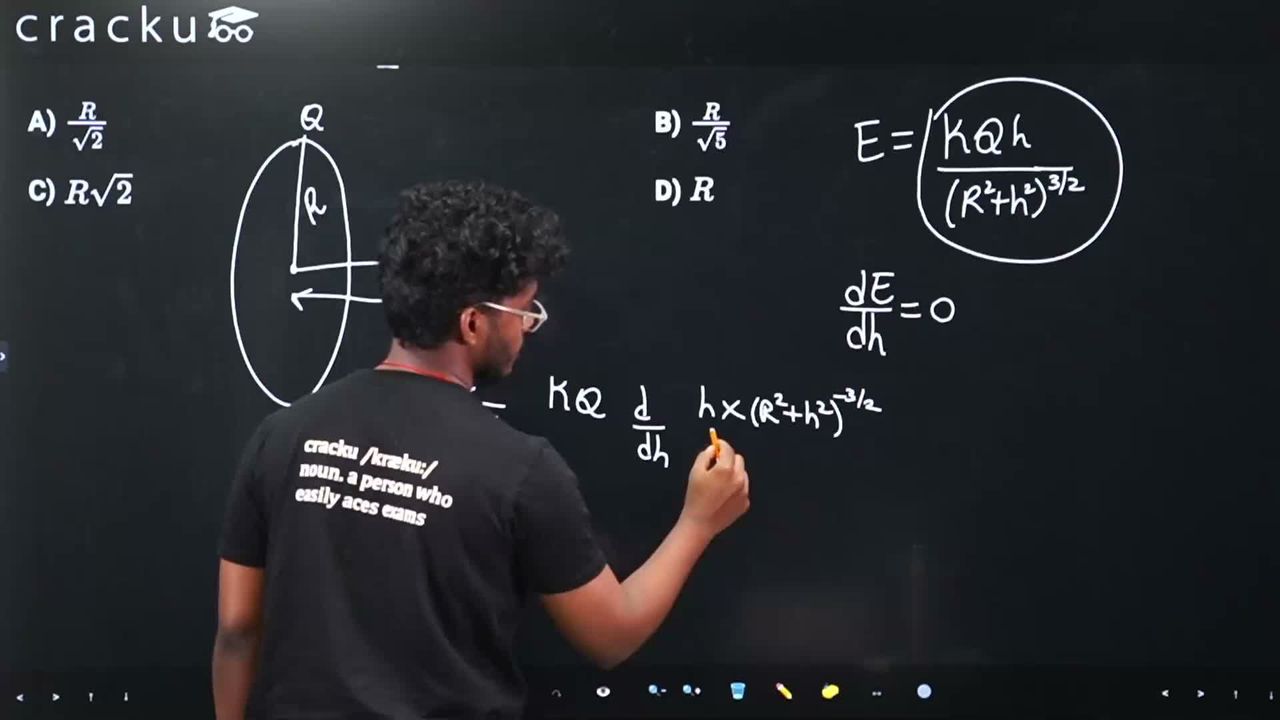
For a uniformly charged ring of radius $$R$$, the electric field on its axis has the largest magnitude at a distance $$h$$ from its centre. Then value of $$h$$ is:
We consider a ring of uniform charge $$Q$$ and radius $$R$$. The point of observation lies on the axis of the ring at a distance $$x$$ (later we shall rename it $$h$$) from the centre. For such a geometry, the standard result for the magnitude of the electric field on the axis is first recalled.
Formula stated: For a uniformly charged ring, the axial electric field magnitude is
$$E(x)=\frac{1}{4\pi\varepsilon_0}\,\frac{Q\,x}{\left(R^{2}+x^{2}\right)^{3/2}}.$$
Here $$\frac{1}{4\pi\varepsilon_0}$$ is the Coulomb constant, $$Q$$ is the total charge, $$R$$ is the ring’s radius and $$x$$ is the axial distance from the centre. We now wish to find the value of $$x$$ for which this function $$E(x)$$ is maximum in magnitude.
To locate an extremum, we differentiate $$E(x)$$ with respect to $$x$$ and set the derivative equal to zero.
First, write $$E(x)$$ in a clearer algebraic form for differentiation:
$$E(x)=kQ\,x\,(R^{2}+x^{2})^{-3/2}, \qquad \text{where }k=\frac{1}{4\pi\varepsilon_0}.$$
We have to find $$\dfrac{dE}{dx}$$. Using the product rule,
$$\frac{dE}{dx}=kQ\Bigg[\frac{d}{dx}\big(x\big)\cdot (R^{2}+x^{2})^{-3/2}+x\cdot\frac{d}{dx}\big((R^{2}+x^{2})^{-3/2}\big)\Bigg].$$
The derivative of the first factor $$x$$ is simply $$1$$. To differentiate the second factor we use the chain rule:
$$\frac{d}{dx}(R^{2}+x^{2})^{-3/2}=-\frac{3}{2}(R^{2}+x^{2})^{-5/2}\cdot 2x =-3x\,(R^{2}+x^{2})^{-5/2}.$$
Substituting this back, we obtain
$$\frac{dE}{dx}=kQ\Big[(R^{2}+x^{2})^{-3/2}+x\big(-3x\,(R^{2}+x^{2})^{-5/2}\big)\Big].$$
Simplify the expression inside the brackets by taking the common factor $$(R^{2}+x^{2})^{-5/2}$$ outside:
$$\frac{dE}{dx}=kQ\,(R^{2}+x^{2})^{-5/2}\Big[(R^{2}+x^{2})-3x^{2}\Big].$$
Combine like terms in the numerator:
$$\frac{dE}{dx}=kQ\,(R^{2}+x^{2})^{-5/2}\big(R^{2}-2x^{2}\big).$$
For an extremum we set $$\dfrac{dE}{dx}=0$$. The constant factors $$kQ$$ and $$(R^{2}+x^{2})^{-5/2}$$ are never zero, so the only factor that can vanish is
$$R^{2}-2x^{2}=0.$$
Solving this simple algebraic equation,
$$R^{2}=2x^{2}\quad\Rightarrow\quad x^{2}=\frac{R^{2}}{2}\quad\Rightarrow\quad x=\frac{R}{\sqrt{2}}.$$
Thus the electric field on the axis is largest when the observation point is at a distance $$h=\dfrac{R}{\sqrt{2}}$$ from the centre of the ring.
Finally, one may check that the second derivative is negative at this value of $$x$$, confirming that it is indeed a maximum, but this step is not required for the answer.
Hence, the correct answer is Option A.
Was this solution helpful?
Click on the Email ☝️ to Watch the Video Solution
Create a FREE account and get:
_1.webp)

Educational materials for JEE preparation

Ask our AI anything

AI can make mistakes. Please verify important information.
AI can make mistakes. Please verify important information.
