
Join Our JEE Preparation Group
Prep with like-minded aspirants; Get access to free daily tests and study material.
Sign in
Please select an account to continue using cracku.in
↓ →
Join Our JEE Preparation Group
Prep with like-minded aspirants; Get access to free daily tests and study material.
Consider two sets A and B, each containing three numbers in A.P. Let the sum and the product of the elements of A be 36 and p respectively and the sum and the product of the elements of B be 36 and q respectively. Let d and D be the common differences of A.P.'s in A and B respectively such that $$D = d + 3, d > 0$$. If $$\frac{p+q}{p-q} = \frac{19}{5}$$, then $$p - q$$ is equal to
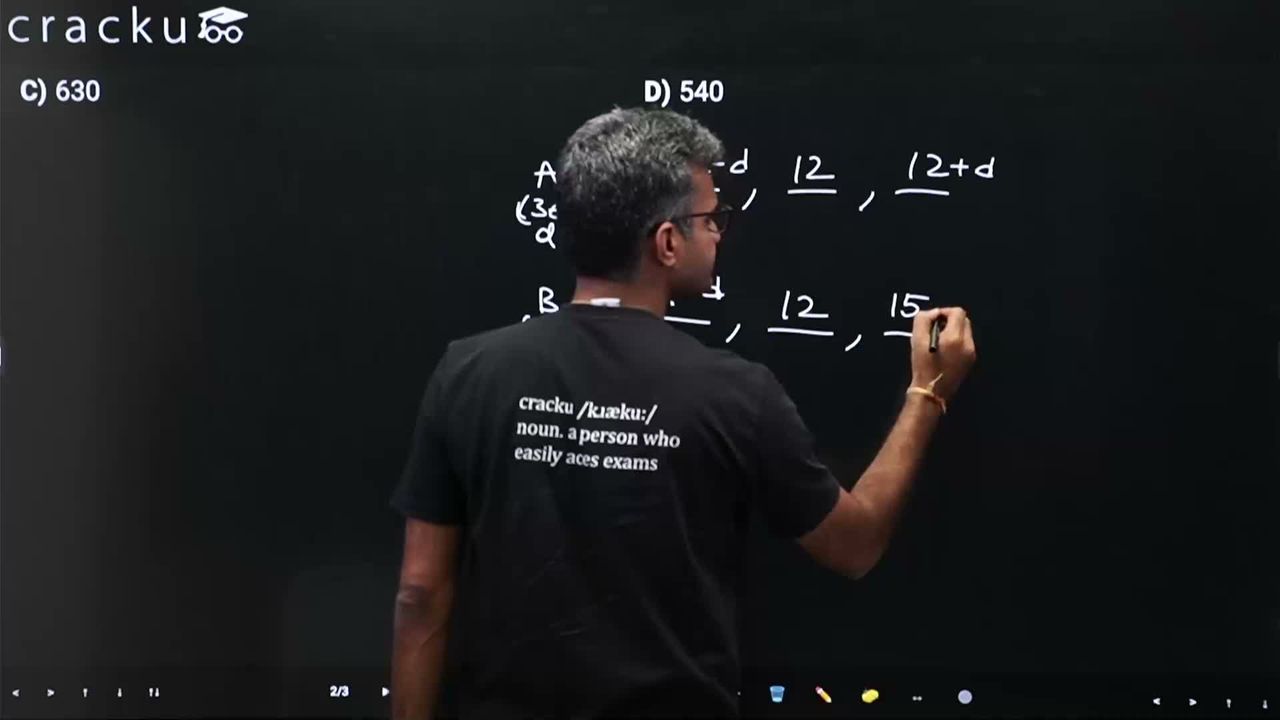
For three numbers in an A.P. we take them symmetrically as $$a-d,\;a,\;a+d$$ where $$d$$ is the common difference.
Set A
Sum of its three terms is given to be $$36$$, hence
$$(a-d)+a+(a+d)=3a=36 \;\Longrightarrow\; a=12$$ $$-(1)$$
Product of the terms of set A is
$$p=(a-d)\,a\,(a+d)=a(a^{2}-d^{2})$$
Putting $$a=12$$ from $$(1)$$,
$$p=12\left(12^{2}-d^{2}\right)=12\left(144-d^{2}\right)=1728-12d^{2}$$ $$-(2)$$
Set B
Its common difference is $$D=d+3$$ with $$d\gt0$$.
Taking the three terms as $$12-D,\;12,\;12+D$$ (centre term still $$12$$ so that their sum is $$36$$), the product becomes
$$q=12\left(12^{2}-D^{2}\right)=12\left(144-(d+3)^{2}\right)$$
Simplifying,
$$(d+3)^{2}=d^{2}+6d+9$$
$$q=12\bigl(144-d^{2}-6d-9\bigr)=12\bigl(135-d^{2}-6d\bigr)$$
$$q=1620-12d^{2}-72d$$ $$-(3)$$
Given condition
$$\frac{p+q}{p-q}=\frac{19}{5}$$ $$-(4)$$
Using $$(2)$$ and $$(3)$$,
$$p+q=\bigl(1728-12d^{2}\bigr)+\bigl(1620-12d^{2}-72d\bigr)=3348-24d^{2}-72d$$
$$p-q=\bigl(1728-12d^{2}\bigr)-\bigl(1620-12d^{2}-72d\bigr)=108+72d$$
Divide numerator and denominator by $$12$$ to keep numbers small:
$$\frac{279-2d^{2}-6d}{9+6d}=\frac{19}{5}$$ $$-(5)$$
Cross-multiplying $$(5)$$ gives
$$5\left(279-2d^{2}-6d\right)=19\left(9+6d\right)$$
$$1395-10d^{2}-30d=171+114d$$
Bring all terms to one side:
$$-10d^{2}-144d+1224=0$$
Multiply by $$-1$$ and simplify by $$2$$:
$$5d^{2}+72d-612=0$$ $$-(6)$$
Solve quadratic $$(6)$$ using the discriminant:
$$\Delta=72^{2}-4\cdot5\cdot(-612)=5184+12240=17424$$
Since $$17424=16\cdot1089=(4\cdot33)^{2}$$, we have $$\sqrt{\Delta}=132$$.
Hence
$$d=\frac{-72\pm132}{10}$$
Positive root (as $$d\gt0$$):
$$d=\frac{60}{10}=6$$
Find $$p-q$$
From $$(p-q)=108+72d$$, substitute $$d=6$$:
$$p-q=108+72\cdot6=108+432=540$$
Therefore, $$p-q=540$$.
Option D
Was this solution helpful?
Click on the Email ☝️ to Watch the Video Solution
Create a FREE account and get:
_1.webp)

Educational materials for JEE preparation

Ask our AI anything

AI can make mistakes. Please verify important information.
AI can make mistakes. Please verify important information.
