
Join Our JEE Preparation Group
Prep with like-minded aspirants; Get access to free daily tests and study material.
Sign in
Please select an account to continue using cracku.in
↓ →
Join Our JEE Preparation Group
Prep with like-minded aspirants; Get access to free daily tests and study material.
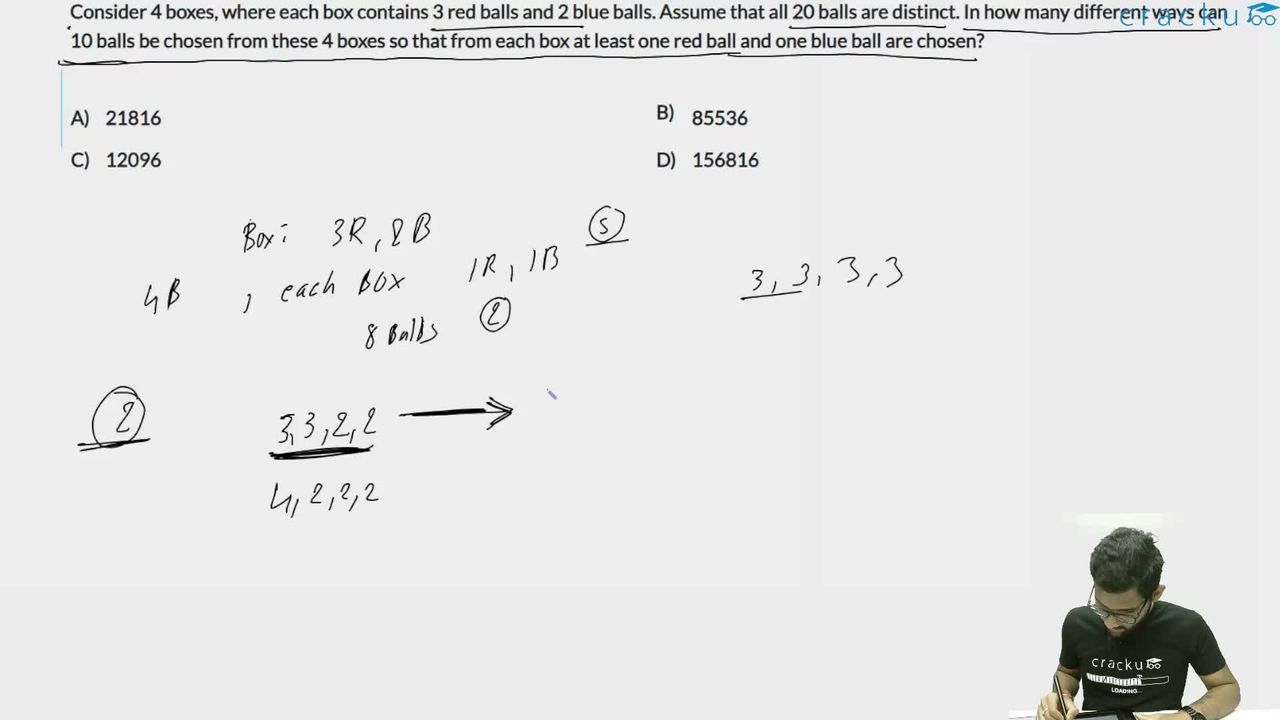
Consider 4 boxes, where each box contains 3 red balls and 2 blue balls. Assume that all 20 balls are distinct. In how many different ways can 10 balls be chosen from these 4 boxes so that from each box at least one red ball and one blue ball are chosen?
Let $$x_i$$ be the number of balls selected from the $$i^{\text{th}}$$ box, $$i = 1,2,3,4$$.
Each box must contribute at least one red and one blue, so $$x_i \ge 2$$ and $$x_i \le 5$$ (since a box contains only 5 balls).
The total number of balls to be chosen is
$$x_1 + x_2 + x_3 + x_4 = 10 \quad -(1)$$
Write $$x_i = 2 + y_i$$, where $$y_i \ge 0$$ and $$y_i \le 3$$. Substituting in $$(1)$$ gives
$$2+ y_1 + 2+ y_2 + 2+ y_3 + 2+ y_4 = 10$$ $$\Longrightarrow y_1 + y_2 + y_3 + y_4 = 2 \quad -(2)$$
Equation $$(2)$$ distributes 2 identical “extra” units among 4 boxes, each box receiving at most 3. Only two types of distributions are possible:
Case 1: One box gets both extras ($$2,0,0,0$$ and its permutations).
Case 2: Two boxes get one extra each ($$1,1,0,0$$ and its permutations).
Translate back to $$x_i$$ values.
Case 1: Pattern $$\{4,2,2,2\}$$ (one box contributes 4 balls, the other three contribute 2 each).
Number of ways to choose which box is the “4” box: $$4$$.
Case 2: Pattern $$\{3,3,2,2\}$$ (two boxes contribute 3 balls each).
Number of ways to choose the two “3” boxes: $${}^{4}C_{2}=6$$.
Next, count the colour-wise selections inside a single box. Let $$(r,b)$$ denote “$$r$$ red and $$b$$ blue” chosen from that box (all balls are distinct).
Possible $$(r,b)$$ pairs and their counts:
The function $$f(x)$$ gives the number of ways to choose balls from one box when that box contributes $$x$$ balls.
Case 1 (\{4,2,2,2\}):
Product of ways for a fixed box pattern: $$f(4)\,f(2)^3 = 5\cdot6^3 = 5\cdot216 = 1080$$.
Including the 4 possible positions of the “4” box:
Total ways $$= 4 \times 1080 = 4320$$.
Case 2 (\{3,3,2,2\}):
Product of ways for a fixed pattern: $$f(3)^2\,f(2)^2 = 9^2 \cdot 6^2 = 81\cdot36 = 2916$$.
Including the $${}^{4}C_{2}=6$$ choices of the two “3” boxes:
Total ways $$= 6 \times 2916 = 17496$$.
Add the two cases:
$$4320 + 17496 = 21816$$
Hence the required number of ways equals $$21816$$.
Option A which is: 21816
Was this solution helpful?
Click on the Email ☝️ to Watch the Video Solution
Create a FREE account and get:
Educational materials for JEE preparation

Ask our AI anything

AI can make mistakes. Please verify important information.
AI can make mistakes. Please verify important information.

_1.webp)
