
Join Our JEE Preparation Group
Prep with like-minded aspirants; Get access to free daily tests and study material.
Sign in
Please select an account to continue using cracku.in
↓ →
Join Our JEE Preparation Group
Prep with like-minded aspirants; Get access to free daily tests and study material.
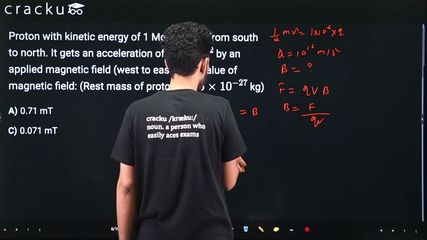
Proton with kinetic energy of 1 MeV moves from south to north. It gets an acceleration of $$10^{12}$$ m/s$$^2$$ by an applied magnetic field (west to east). The value of magnetic field: (Rest mass of proton is $$1.6 \times 10^{-27}$$ kg)
We are given that a proton possesses a kinetic energy of $$1\ \text{MeV}$$ and is travelling from south to north. First, we convert this energy into joules because the usual mechanical formulas employ SI units.
$$1\ \text{MeV}=1\times10^{6}\ \text{eV}=1\times10^{6}\times1.6\times10^{-19}\ \text{J}=1.6\times10^{-13}\ \text{J}$$
The classical relation between kinetic energy and speed is stated as
$$K=\frac12\,m\,v^{2}$$
where $$K$$ is the kinetic energy, $$m$$ the mass and $$v$$ the speed. Substituting $$K=1.6\times10^{-13}\ \text{J}$$ and $$m=1.6\times10^{-27}\ \text{kg}$$ (rest mass of the proton), we get
$$1.6\times10^{-13}=\frac12\,(1.6\times10^{-27})\,v^{2}$$
Multiplying both sides by 2 to remove the fraction,
$$2\times1.6\times10^{-13}=(1.6\times10^{-27})\,v^{2}$$
Notice that the factor $$1.6$$ appears on both sides, so it cancels:
$$2\times10^{-13}=10^{-27}\,v^{2}$$
Dividing by $$10^{-27}$$, we have
$$v^{2}=2\times10^{14}$$
Taking the square root,
$$v=\sqrt{2}\times10^{7}\ \text{m s}^{-1}\approx1.414\times10^{7}\ \text{m s}^{-1}$$
Now, the proton experiences an acceleration of $$10^{12}\ \text{m s}^{-2}$$ due to a magnetic field directed from west to east, while its velocity is south to north. The magnetic force formula is first stated:
$$\mathbf{F}=q\,\mathbf{v}\times\mathbf{B}$$
The magnitude of this force when $$\mathbf{v}$$ and $$\mathbf{B}$$ are perpendicular is
$$F=q\,v\,B$$
According to Newton’s second law, this force produces an acceleration $$a$$, so
$$F=m\,a$$
Equating the two expressions for the force gives
$$m\,a=q\,v\,B$$
Solving for the magnetic field magnitude $$B$$,
$$B=\frac{m\,a}{q\,v}$$
We substitute $$m=1.6\times10^{-27}\ \text{kg}$$, $$a=10^{12}\ \text{m s}^{-2}$$, $$q=1.6\times10^{-19}\ \text{C}$$ and $$v=1.414\times10^{7}\ \text{m s}^{-1}$$:
$$B=\frac{(1.6\times10^{-27})(10^{12})}{(1.6\times10^{-19})(1.414\times10^{7})}$$
Simplifying the numerator,
$$1.6\times10^{-27}\times10^{12}=1.6\times10^{-15}$$
Simplifying the denominator,
$$(1.6\times10^{-19})(1.414\times10^{7})=1.6\times1.414\times10^{-12}=2.2624\times10^{-12}$$
Hence,
$$B=\frac{1.6\times10^{-15}}{2.2624\times10^{-12}}=\frac{1.6}{2.2624}\times10^{-3}\ \text{T}$$
Calculating the numerical ratio,
$$\frac{1.6}{2.2624}\approx0.707$$
Therefore,
$$B\approx0.707\times10^{-3}\ \text{T}=0.707\ \text{mT}$$
This value matches closely with $$0.71\ \text{mT}$$.
Hence, the correct answer is Option A.
Was this solution helpful?
Click on the Email ☝️ to Watch the Video Solution
Create a FREE account and get:
_1.webp)

Educational materials for JEE preparation

Ask our AI anything

AI can make mistakes. Please verify important information.
AI can make mistakes. Please verify important information.
