
Join Our JEE Preparation Group
Prep with like-minded aspirants; Get access to free daily tests and study material.
Sign in
Please select an account to continue using cracku.in
↓ →
Join Our JEE Preparation Group
Prep with like-minded aspirants; Get access to free daily tests and study material.
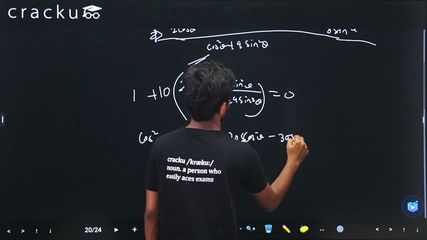
Let $$A = \left\{\theta \in [0, 2\pi] : 1 + 10\text{Re}\left(\frac{2\cos\theta + i\sin\theta}{\cos\theta - 3i\sin\theta}\right) = 0\right\}$$. Then $$\sum_{\theta \in A} \theta^2$$ is equal to
Write $$\cos\theta = c$$ and $$\sin\theta = s$$ for brevity.
The given condition is
$$1 + 10\,\text{Re}\!\left(\dfrac{2c + i\,s}{\,c - 3i\,s}\right)=0$$
which can be rearranged as
$$\text{Re}\!\left(\dfrac{2c + i\,s}{\,c - 3i\,s}\right)= -\dfrac1{10}\,\,\,\,\,\,-(1)$$
To extract the real part, multiply numerator and denominator by the conjugate of the denominator:
$$\dfrac{2c + i\,s}{\,c - 3i\,s} =\dfrac{(2c + i\,s)(c + 3i\,s)}{(c - 3i\,s)(c + 3i\,s)} =\dfrac{(2c + i\,s)(c + 3i\,s)}{c^2 + 9s^2}$$
Expand the numerator:
$$\begin{aligned}
(2c + i\,s)(c + 3i\,s)
&= 2c\cdot c + 2c\cdot 3i\,s + i\,s\cdot c + i\,s\cdot 3i\,s\\
&= 2c^2 + 6i\,cs + i\,cs + 3i^2s^2\\
&= 2c^2 + 7i\,cs - 3s^2
\end{aligned}$$
Thus
$$\dfrac{2c + i\,s}{\,c - 3i\,s}
=\dfrac{\,2c^2 - 3s^2}{c^2 + 9s^2}
+ i\,\dfrac{7cs}{c^2 + 9s^2}$$
Hence the real part is
$$\text{Re} = \dfrac{\,2c^2 - 3s^2}{c^2 + 9s^2}$$
Insert this into $$(1)$$:
$$\dfrac{\,2c^2 - 3s^2}{c^2 + 9s^2} = -\dfrac1{10}$$
Cross-multiply:
$$10(2c^2 - 3s^2) = -(c^2 + 9s^2)$$
$$20c^2 - 30s^2 + c^2 + 9s^2 = 0$$
$$21c^2 - 21s^2 = 0$$
$$c^2 = s^2$$
Therefore $$|\,\cos\theta| = |\,\sin\theta|$$, which is equivalent to
$$\tan^2\theta = 1 \; \Longrightarrow \; \theta = \dfrac{\pi}{4} + k\dfrac{\pi}{2}, \; k \in \mathbb{Z}$$
Within the interval $$[0, 2\pi]$$ the admissible angles are
$$\theta_1 = \dfrac{\pi}{4},\; \theta_2 = \dfrac{3\pi}{4},\;
\theta_3 = \dfrac{5\pi}{4},\; \theta_4 = \dfrac{7\pi}{4}$$
Compute the required sum:
$$\sum_{\theta\in A} \theta^2
= \left(\dfrac{\pi}{4}\right)^2
+ \left(\dfrac{3\pi}{4}\right)^2
+ \left(\dfrac{5\pi}{4}\right)^2
+ \left(\dfrac{7\pi}{4}\right)^2$$
$$= \dfrac{\pi^2}{16} + \dfrac{9\pi^2}{16}
+ \dfrac{25\pi^2}{16} + \dfrac{49\pi^2}{16}
= \dfrac{84\pi^2}{16}
= \dfrac{21}{4}\pi^2$$
Hence $$\displaystyle \sum_{\theta \in A} \theta^2 = \dfrac{21}{4}\pi^2$$, which matches Option A.
Was this solution helpful?
Click on the Email ☝️ to Watch the Video Solution
Create a FREE account and get:
_1.webp)

Educational materials for JEE preparation

Ask our AI anything

AI can make mistakes. Please verify important information.
AI can make mistakes. Please verify important information.
