
Join Our JEE Preparation Group
Prep with like-minded aspirants; Get access to free daily tests and study material.
Sign in
Please select an account to continue using cracku.in
↓ →
Join Our JEE Preparation Group
Prep with like-minded aspirants; Get access to free daily tests and study material.
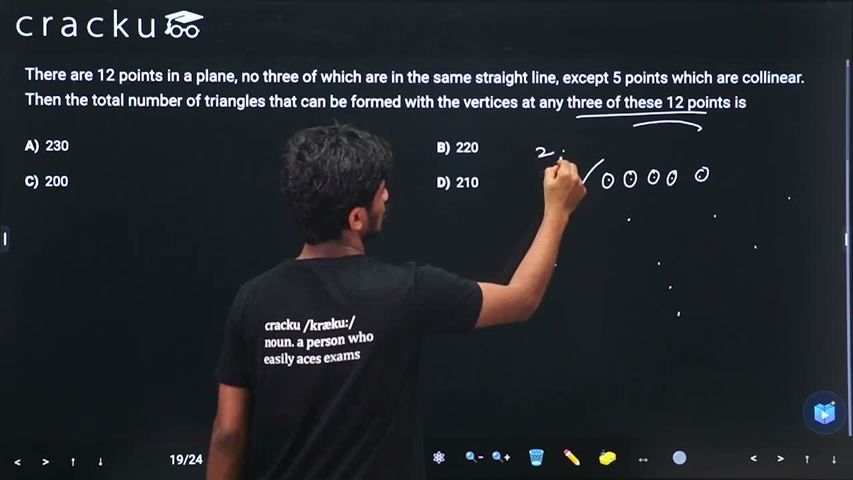
There are 12 points in a plane, no three of which are in the same straight line, except 5 points which are collinear. Then the total number of triangles that can be formed with the vertices at any three of these 12 points is
Any triangle is completely determined by choosing its three vertices.
Therefore, start by counting all possible selections of three points from the 12 points.
Total unordered triples of points $$= {}^{12}C_{3} = \frac{12 \times 11 \times 10}{3 \times 2 \times 1} = 220$$ $$-(1)$$
A triangle cannot be formed if all three chosen points lie on the same straight line. The only collinear points given are the 5 points on one common line; all other triples are non-collinear.
Number of degenerate (collinear) triples $$= {}^{5}C_{3} = \frac{5 \times 4 \times 3}{3 \times 2 \times 1} = 10$$ $$-(2)$$
Subtract these degenerate cases from the total in $$(1)$$ to obtain the required number of triangles:
Required triangles $$= 220 - 10 = 210$$
Hence, the total number of distinct triangles that can be formed is $$210$$. Option D is correct.
Was this solution helpful?
Click on the Email ☝️ to Watch the Video Solution
Create a FREE account and get:
_1.webp)

Educational materials for JEE preparation

Ask our AI anything

AI can make mistakes. Please verify important information.
AI can make mistakes. Please verify important information.
