
Join Our JEE Preparation Group
Prep with like-minded aspirants; Get access to free daily tests and study material.
Sign in
Please select an account to continue using cracku.in
↓ →
Join Our JEE Preparation Group
Prep with like-minded aspirants; Get access to free daily tests and study material.
In an LCR circuit shown below, both the switches are open initially. Now switch $$S_1$$ is closed, $$S_2$$ kept open. (q is charge on the capacitor and $$\tau$$ = RC is capacitive time constant). Which of the following statement is correct?
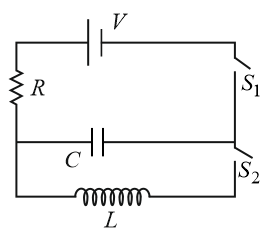
The charge $$q$$ on the capacitor at any time $$t$$ is given by the charging equation $$q(t) = CV(1 - e^{-t/\tau})$$, where $$\tau = RC$$ is the capacitive time constant.
Option A: At $$t = 2\tau$$: $$q = CV(1 - e^{-2\tau/\tau}) = CV(1 - e^{-2})$$
Option B: At $$t = \frac{\tau}{2}$$: $$q = CV(1 - e^{-(\tau/2)/\tau}) = CV(1 - e^{-1/2})$$
Option C: For a capacitor charging to its maximum, the work done by the battery is $$W = CV^2$$. The energy stored in the capacitor is $$U = \frac{1}{2}CV^2$$, and the energy dissipated in the resistor is also $$E_R = \frac{1}{2}CV^2$$. Therefore, the work done by the battery is twice the energy dissipated.
Option D: At $$t = \tau$$: $$q = CV(1 - e^{-1}) \approx 0.63 CV$$
Was this solution helpful?
Create a FREE account and get:
_1.webp)

Educational materials for JEE preparation

Ask our AI anything

AI can make mistakes. Please verify important information.
AI can make mistakes. Please verify important information.
