
Join Our JEE Preparation Group
Prep with like-minded aspirants; Get access to free daily tests and study material.
Sign in
Please select an account to continue using cracku.in
↓ →
Join Our JEE Preparation Group
Prep with like-minded aspirants; Get access to free daily tests and study material.
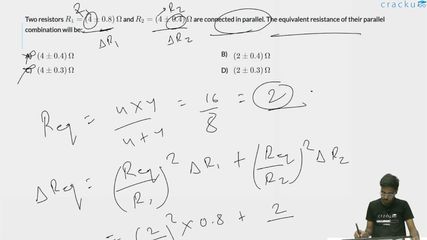
Two resistors $$R_1 = (4 \pm 0.8)$$ $$\Omega$$ and $$R_2 = (4 \pm 0.4)$$ $$\Omega$$ are connected in parallel. The equivalent resistance of their parallel combination will be:
We have two resistors whose measured values are
$$R_1 = 4 \;\Omega \pm 0.8 \;\Omega , \qquad R_2 = 4 \;\Omega \pm 0.4 \;\Omega.$$
When resistors are connected in parallel, the equivalent resistance $$R_p$$ is obtained from the relation
$$\frac{1}{R_p} \;=\; \frac{1}{R_1} + \frac{1}{R_2}.$$
Instead of working with reciprocals, it is convenient to use the algebraically equivalent form
$$R_p \;=\; \frac{R_1 R_2}{R_1 + R_2}.$$
First we calculate the central (nominal) value by substituting the central values $$R_1 = 4 \;\Omega$$ and $$R_2 = 4 \;\Omega$$:
$$R_p = \frac{4 \times 4}{4 + 4} = \frac{16}{8} = 2 \;\Omega.$$
Now we must estimate the maximum possible error in $$R_p$$ that arises from the individual errors in $$R_1$$ and $$R_2$$. For a function of several variables, the (maximum) absolute error is obtained by adding the absolute values of the first‐order differentials:
$$\Delta R_p \;=\; \left| \frac{\partial R_p}{\partial R_1} \right|\! \Delta R_1 \;+\; \left| \frac{\partial R_p}{\partial R_2} \right|\! \Delta R_2.$$
So we need the partial derivatives of $$R_p = \dfrac{R_1 R_2}{R_1 + R_2}$$ with respect to each resistor.
Starting with $$R_1$$:
$$\frac{\partial R_p}{\partial R_1} = \frac{(R_1 + R_2)\,R_2 - R_1 R_2}{(R_1 + R_2)^2} = \frac{R_2^2}{(R_1 + R_2)^2}.$$
Similarly, for $$R_2$$ we have
$$\frac{\partial R_p}{\partial R_2} = \frac{R_1^2}{(R_1 + R_2)^2}.$$
Substituting the nominal values $$R_1 = R_2 = 4 \;\Omega$$ gives
$$R_1 + R_2 = 8 \;\Omega \;\;\Longrightarrow\;\; (R_1 + R_2)^2 = 64,$$
$$\frac{\partial R_p}{\partial R_1} = \frac{4^2}{64} = \frac{16}{64} = 0.25,$$
$$\frac{\partial R_p}{\partial R_2} = \frac{4^2}{64} = 0.25.$$
Now insert the absolute errors $$\Delta R_1 = 0.8 \;\Omega$$ and $$\Delta R_2 = 0.4 \;\Omega$$:
$$\Delta R_p = 0.25 \times 0.8 \;+\; 0.25 \times 0.4 = 0.20 + 0.10 = 0.30 \;\Omega.$$
Therefore, the equivalent resistance with its maximum possible error is
$$R_p = 2 \;\Omega \pm 0.3 \;\Omega.$$
Hence, the correct answer is Option D.
Click on the Email ☝️ to Watch the Video Solution
Create a FREE account and get:
_1.webp)

Educational materials for JEE preparation

Ask our AI anything

AI can make mistakes. Please verify important information.
AI can make mistakes. Please verify important information.


