
Join Our JEE Preparation Group
Prep with like-minded aspirants; Get access to free daily tests and study material.
Sign in
Please select an account to continue using cracku.in
↓ →
Join Our JEE Preparation Group
Prep with like-minded aspirants; Get access to free daily tests and study material.
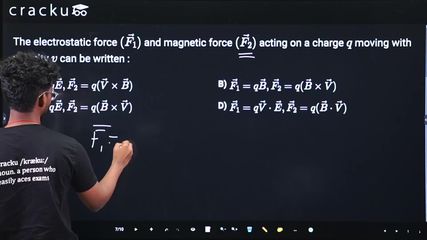
The electrostatic force $$(\vec{F_1})$$ and magnetic force $$(\vec{F_2})$$ acting on a charge $$q$$ moving with velocity $$v$$ can be written :
This question asks for the correct expressions for the electrostatic force and magnetic force acting on a charge $$q$$ moving with velocity $$\vec{v}$$.
Recall that the electrostatic force on a charge $$q$$ in an electric field $$\vec{E}$$ is given by:
$$\vec{F_1} = q\vec{E}$$
This force acts in the direction of $$\vec{E}$$ for a positive charge and opposite to $$\vec{E}$$ for a negative charge. Importantly, this force does not depend on the velocity of the charge.
The magnetic force on a charge $$q$$ moving with velocity $$\vec{v}$$ in a magnetic field $$\vec{B}$$ is given by:
$$\vec{F_2} = q(\vec{v} \times \vec{B})$$
Key features of this force:
- It involves the cross product of velocity and magnetic field, not a dot product.
- The order matters: it is $$\vec{v} \times \vec{B}$$, not $$\vec{B} \times \vec{v}$$ (they differ by a negative sign).
- This force is always perpendicular to both $$\vec{v}$$ and $$\vec{B}$$, so it does no work on the charge.
- If the charge is stationary ($$\vec{v} = 0$$), the magnetic force is zero.
Comparing with the given options shows that option (1) gives $$\vec{F_1} = q\vec{E}$$ and $$\vec{F_2} = q(\vec{V} \times \vec{B})$$, which matches both formulas correctly.
Option (2) incorrectly uses $$\vec{B}$$ for the electrostatic force.
Option (3) has the cross product in the wrong order ($$\vec{B} \times \vec{V}$$).
Option (4) incorrectly uses dot products instead of cross products.
The correct answer is Option (1): $$\vec{F_1} = q\vec{E}$$, $$\vec{F_2} = q(\vec{V} \times \vec{B})$$.
Was this solution helpful?
Click on the Email ☝️ to Watch the Video Solution
Create a FREE account and get:
_1.webp)

Educational materials for JEE preparation

Ask our AI anything

AI can make mistakes. Please verify important information.
AI can make mistakes. Please verify important information.
