
Join Our JEE Preparation Group
Prep with like-minded aspirants; Get access to free daily tests and study material.
Sign in
Please select an account to continue using cracku.in
↓ →
Join Our JEE Preparation Group
Prep with like-minded aspirants; Get access to free daily tests and study material.
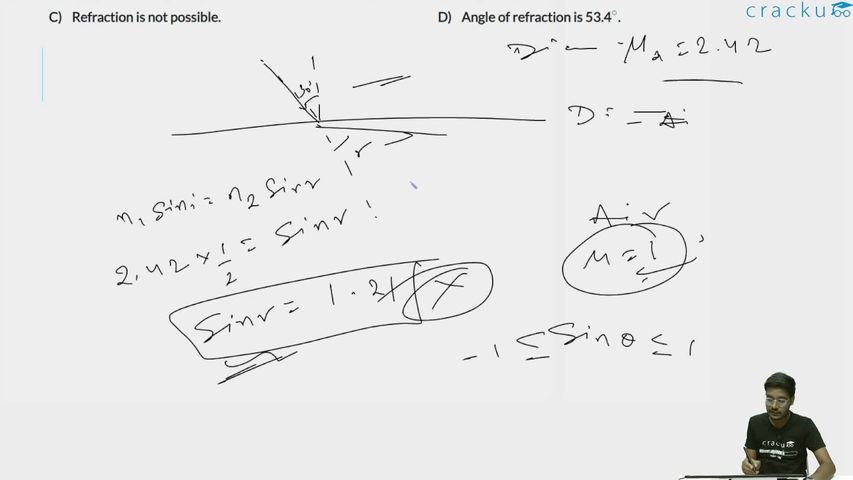
A ray of laser of a wavelength 630 nm is incident at an angle of 30$$^\circ$$ at the diamond-air interface. It is going from diamond to air. The refractive index of diamond is 2.42 and that of air is 1. Choose the correct option.
We begin by listing the known quantities. The refractive index of diamond is $$n_1 = 2.42$$, the refractive index of air is $$n_2 = 1.00$$ and the angle of incidence (measured from the normal) is $$i = 30^\circ$$. A ray is travelling from the denser medium (diamond) to the rarer medium (air).
Whenever light passes from one medium to another, the relationship between the angle of incidence $$i$$ and the angle of refraction $$r$$ is given by Snell’s law, which states
$$n_1 \sin i \;=\; n_2 \sin r.$$
Substituting the given numerical values, we have
$$2.42 \,\sin 30^\circ \;=\; 1.00 \,\sin r.$$
Now, $$\sin 30^\circ = \dfrac{1}{2}$$, so the left-hand side becomes
$$2.42 \times \dfrac{1}{2} = 1.21.$$
Hence the equation reduces to
$$1.21 = \sin r.$$
But the sine of any real angle can never exceed 1, i.e. $$\sin r \le 1$$ for all real $$r$$. Since $$1.21 > 1$$, the condition $$\sin r = 1.21$$ is physically impossible. This tells us that the ray cannot refract into air; instead, total internal reflection must occur.
To reinforce this conclusion, we can calculate the critical angle $$\theta_c$$ for the diamond-air interface. Total internal reflection happens when the angle of incidence exceeds this critical angle. The critical angle is obtained by setting $$r = 90^\circ$$ in Snell’s law:
$$n_1 \sin \theta_c = n_2 \sin 90^\circ.$$
Since $$\sin 90^\circ = 1$$, we get
$$\sin \theta_c = \dfrac{n_2}{n_1} = \dfrac{1.00}{2.42} \approx 0.413.$$
Therefore
$$\theta_c = \sin^{-1}(0.413) \approx 24.4^\circ.$$
The given angle of incidence is $$30^\circ$$, which is clearly greater than $$24.4^\circ$$. Hence the ray is indeed incident at an angle larger than the critical angle, confirming total internal reflection and the impossibility of refraction.
Hence, the correct answer is Option C.
Was this solution helpful?
Click on the Email ☝️ to Watch the Video Solution
Create a FREE account and get:
_1.webp)

Educational materials for JEE preparation

Ask our AI anything

AI can make mistakes. Please verify important information.
AI can make mistakes. Please verify important information.
