
Join Our JEE Preparation Group
Prep with like-minded aspirants; Get access to free daily tests and study material.
Sign in
Please select an account to continue using cracku.in
↓ →
Join Our JEE Preparation Group
Prep with like-minded aspirants; Get access to free daily tests and study material.
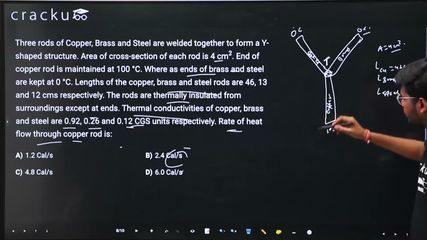
Three rods of Copper, Brass and Steel are welded together to form a Y-shaped structure. Area of cross-section of each rod is 4 cm$$^2$$. End of copper rod is maintained at 100 °C. Where as ends of brass and steel are kept at 0 °C. Lengths of the copper, brass and steel rods are 46, 13 and 12 cms respectively. The rods are thermally insulated from surroundings except at ends. Thermal conductivities of copper, brass and steel are 0.92, 0.26 and 0.12 CGS units respectively. Rate of heat flow through copper rod is:
In steady-state heat conduction, the heat current through a uniform rod is given by the formula
$$Q \;=\; \dfrac{k\,A\,(\theta_1-\theta_2)}{L},$$
where $$k$$ is the thermal conductivity, $$A$$ the cross-sectional area, $$L$$ the length of the rod and $$(\theta_1-\theta_2)$$ the temperature difference between its ends.
All three rods have the same cross-section $$A = 4\ \text{cm}^2$$. The given data are
$$\begin{aligned} k_{\text{Cu}} &= 0.92, & L_{\text{Cu}} &= 46\ \text{cm}, & \theta_{\text{hot}} &= 100^\circ\text{C},\\[2mm] k_{\text{Br}} &= 0.26, & L_{\text{Br}} &= 13\ \text{cm}, & \theta_{\text{cold}} &= 0^\circ\text{C},\\[2mm] k_{\text{St}} &= 0.12, & L_{\text{St}} &= 12\ \text{cm}. & \end{aligned}$$
Let the common junction temperature be $$T^\circ\text{C}$$. Because the system is insulated elsewhere and has reached steady state,
$$\text{(heat entering through copper)}\;=\;\text{(heat leaving through brass)}\;+\;\text{(heat leaving through steel)}.$$
First we calculate the thermal conductance of each rod, $$G = \dfrac{kA}{L}$$.
For copper:
$$G_{\text{Cu}} \;=\; \dfrac{0.92 \times 4}{46} \;=\; \dfrac{3.68}{46} \;=\; 0.08\ \text{(cal/s)}/^\circ\text{C}.$$
For brass:
$$G_{\text{Br}} \;=\; \dfrac{0.26 \times 4}{13} \;=\; \dfrac{1.04}{13} \;=\; 0.08\ \text{(cal/s)}/^\circ\text{C}.$$
For steel:
$$G_{\text{St}} \;=\; \dfrac{0.12 \times 4}{12} \;=\; \dfrac{0.48}{12} \;=\; 0.04\ \text{(cal/s)}/^\circ\text{C}.$$
Now we write the heat-balance equation:
$$G_{\text{Cu}}\,(100 - T) \;=\; G_{\text{Br}}\,T \;+\; G_{\text{St}}\,T.$$
Substituting the conductances,
$$0.08\,(100 - T) \;=\; 0.08\,T \;+\; 0.04\,T.$$
Combining the terms on the right:
$$0.08\,(100 - T) \;=\; 0.12\,T.$$
Expanding the left side:
$$8 \;-\; 0.08\,T \;=\; 0.12\,T.$$
Bringing like terms together:
$$8 \;=\; 0.12\,T + 0.08\,T \;=\; 0.20\,T.$$
Hence
$$T \;=\; \dfrac{8}{0.20} \;=\; 40^\circ\text{C}.$$
We now find the required heat current through the copper rod:
$$Q_{\text{Cu}} \;=\; G_{\text{Cu}}\,(100 - T) \;=\; 0.08\,(100 - 40) \;=\; 0.08 \times 60 \;=\; 4.8\ \text{cal}\,\text{s}^{-1}.$$
Hence, the correct answer is Option C.
Was this solution helpful?
Click on the Email ☝️ to Watch the Video Solution
Create a FREE account and get:
_1.webp)

Educational materials for JEE preparation

Ask our AI anything

AI can make mistakes. Please verify important information.
AI can make mistakes. Please verify important information.


