
Join Our JEE Preparation Group
Prep with like-minded aspirants; Get access to free daily tests and study material.
Sign in
Please select an account to continue using cracku.in
↓ →
Join Our JEE Preparation Group
Prep with like-minded aspirants; Get access to free daily tests and study material.
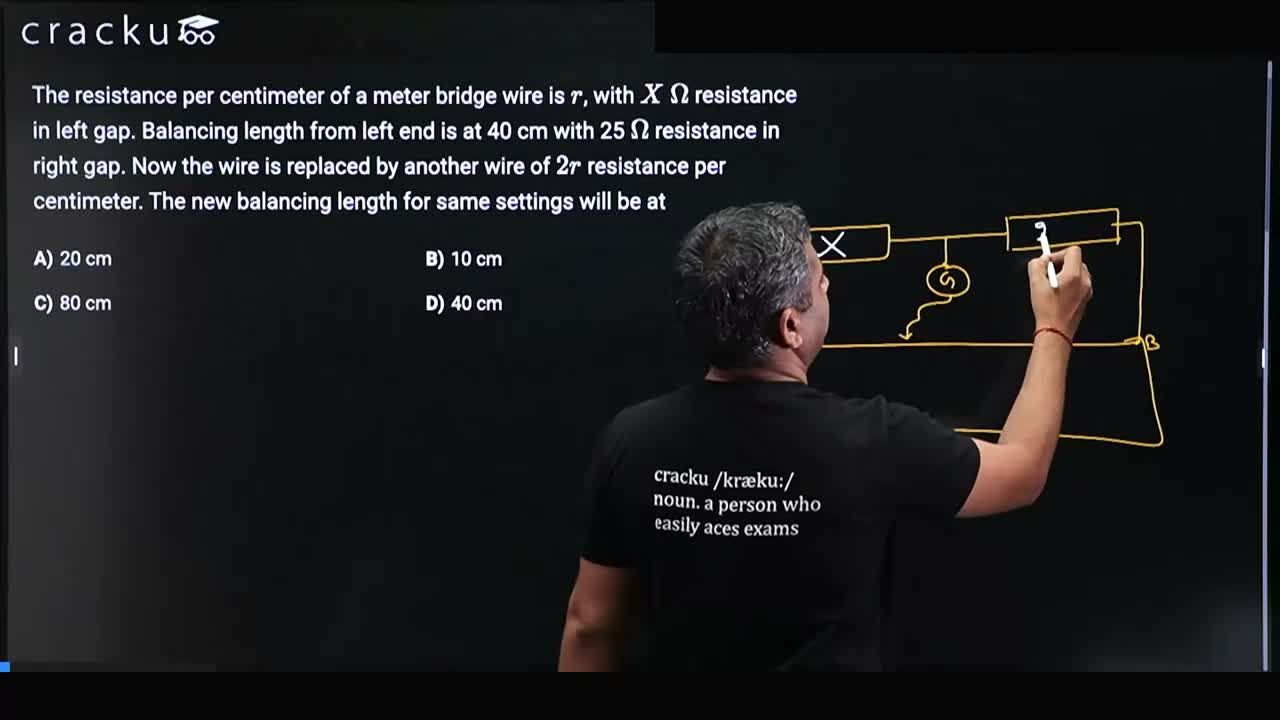
The resistance per centimeter of a meter bridge wire is $$r$$, with $$X$$ $$\Omega$$ resistance in left gap. Balancing length from left end is at 40 cm with 25 $$\Omega$$ resistance in right gap. Now the wire is replaced by another wire of $$2r$$ resistance per centimeter. The new balancing length for same settings will be at
We need to determine the new balancing length in a meter bridge when the wire is replaced.
The balance condition in a meter bridge is $$\frac{X}{R} = \frac{R_l}{R_{100-l}}$$ where $$R_l$$ and $$R_{100-l}$$ are the resistances of the wire on the two sides. Since the resistance of a uniform wire is proportional to its length, this becomes $$\frac{X}{R} = \frac{r \cdot l}{r \cdot (100-l)} = \frac{l}{100-l}$$ and hence the resistance per cm ($$r$$) cancels out.
Substituting the original values gives $$\frac{X}{25} = \frac{40}{60} = \frac{2}{3}$$, so $$X = \frac{50}{3}$$ ohm.
When the wire is replaced by one with resistance $$2r$$ per cm, we have $$\frac{X}{25} = \frac{2r \cdot l'}{2r \cdot (100-l')} = \frac{l'}{100-l'}$$. The $$2r$$ cancels from both sides, giving the same equation as before.
Therefore, the balancing length remains $$l' = 40$$ cm.
The correct answer is Option 4: 40 cm.
Was this solution helpful?
Click on the Email ☝️ to Watch the Video Solution
Create a FREE account and get:
_1.webp)

Educational materials for JEE preparation

Ask our AI anything

AI can make mistakes. Please verify important information.
AI can make mistakes. Please verify important information.
