
Join Our JEE Preparation Group
Prep with like-minded aspirants; Get access to free daily tests and study material.
Sign in
Please select an account to continue using cracku.in
↓ →
Join Our JEE Preparation Group
Prep with like-minded aspirants; Get access to free daily tests and study material.
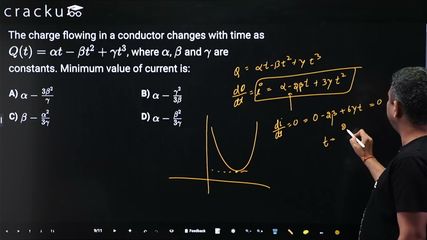
The charge flowing in a conductor changes with time as $$Q(t) = \alpha t - \beta t^2 + \gamma t^3$$, where $$\alpha$$, $$\beta$$ and $$\gamma$$ are constants. Minimum value of current is:
The charge flowing in a conductor is $$Q(t) = \alpha t - \beta t^2 + \gamma t^3$$.
$$I(t) = \frac{dQ}{dt} = \alpha - 2\beta t + 3\gamma t^2$$
$$\frac{dI}{dt} = -2\beta + 6\gamma t = 0$$
$$t = \frac{\beta}{3\gamma}$$
Since $$\frac{d^2I}{dt^2} = 6\gamma > 0$$ (assuming $$\gamma > 0$$), this is indeed a minimum.
$$I_{\min} = \alpha - 2\beta \cdot \frac{\beta}{3\gamma} + 3\gamma \cdot \frac{\beta^2}{9\gamma^2}$$
$$= \alpha - \frac{2\beta^2}{3\gamma} + \frac{\beta^2}{3\gamma}$$
$$= \alpha - \frac{\beta^2}{3\gamma}$$
The minimum value of current is $$\alpha - \frac{\beta^2}{3\gamma}$$.
The correct answer is Option 4: $$\alpha - \frac{\beta^2}{3\gamma}$$.
3015150
Was this solution helpful?
Click on the Email ☝️ to Watch the Video Solution
Create a FREE account and get:
_1.webp)

Educational materials for JEE preparation

Ask our AI anything

AI can make mistakes. Please verify important information.
AI can make mistakes. Please verify important information.


