
Join Our JEE Preparation Group
Prep with like-minded aspirants; Get access to free daily tests and study material.
Sign in
Please select an account to continue using cracku.in
↓ →
Join Our JEE Preparation Group
Prep with like-minded aspirants; Get access to free daily tests and study material.
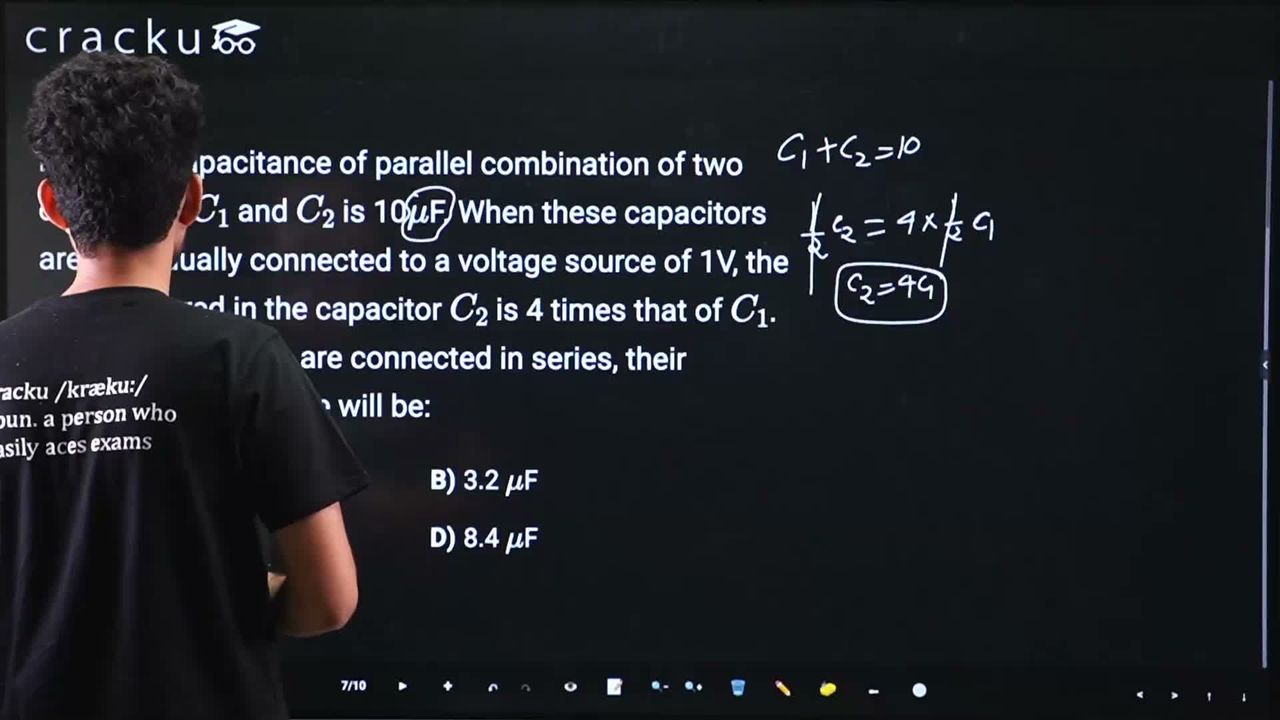
Effective capacitance of parallel combination of two capacitors $$C_1$$ and $$C_2$$ is 10$$\mu$$F. When these capacitors are individually connected to a voltage source of 1V, the energy stored in the capacitor $$C_2$$ is 4 times that of $$C_1$$. If these capacitors are connected in series, their effective capacitance will be:
We are told that two capacitors $$C_1$$ and $$C_2$$ are first connected in parallel and their equivalent (effective) capacitance is measured to be $$10\;\mu\text{F}$$.
For capacitors joined in parallel, the equivalent capacitance is simply the sum of the individual capacitances. Therefore we write the relation first:
$$C_{\text{parallel}} \;=\; C_1 + C_2$$
Substituting the given value $$C_{\text{parallel}} = 10\;\mu\text{F}$$, we have
$$C_1 + C_2 = 10\;\mu\text{F} \quad -(1)$$
Next, each capacitor is separately connected to a voltage source of $$1\;\text{V}$$. The energy stored in a capacitor is given by the basic formula
$$U = \dfrac{1}{2}\,C\,V^{2}$$
Applying this formula to the first capacitor, which has capacitance $$C_1$$ and voltage $$V = 1\;\text{V}$$, we get
$$U_1 = \dfrac{1}{2}\,C_1\,(1)^2 = \dfrac{1}{2}C_1$$
In the same way, for the second capacitor $$C_2$$ we obtain
$$U_2 = \dfrac{1}{2}\,C_2\,(1)^2 = \dfrac{1}{2}C_2$$
The problem states that the energy stored in $$C_2$$ is four times the energy stored in $$C_1$$. Hence we set up the proportionality condition
$$U_2 = 4\,U_1$$
Substituting the expressions for $$U_1$$ and $$U_2$$ found above, we write
$$\dfrac{1}{2}C_2 = 4 \times \left(\dfrac{1}{2}C_1\right)$$
The factor $$\dfrac{1}{2}$$ is common on both sides, allowing it to be cancelled, giving us the direct relation between the capacitances:
$$C_2 = 4C_1 \quad -(2)$$
Now we possess two linear equations: equation (1) $$C_1 + C_2 = 10$$ and equation (2) $$C_2 = 4C_1$$. We substitute equation (2) into equation (1) to solve for $$C_1$$:
$$C_1 + 4C_1 = 10$$
Simplifying the left-hand side, we find
$$5C_1 = 10$$
Dividing both sides by 5, we obtain
$$C_1 = 2\;\mu\text{F}$$
To find $$C_2$$ we return to equation (2):
$$C_2 = 4C_1 = 4 \times 2\;\mu\text{F} = 8\;\mu\text{F}$$
Having identified the individual capacitances $$C_1 = 2\;\mu\text{F}$$ and $$C_2 = 8\;\mu\text{F}$$, we now connect them in series and determine their new equivalent capacitance. For capacitors in series, the standard formula is
$$\dfrac{1}{C_{\text{series}}} = \dfrac{1}{C_1} + \dfrac{1}{C_2}$$
Substituting the numerical values, we write
$$\dfrac{1}{C_{\text{series}}} = \dfrac{1}{2\;\mu\text{F}} + \dfrac{1}{8\;\mu\text{F}}$$
We express both fractions with a common denominator of $$8\;\mu\text{F}$$ to combine them easily:
$$\dfrac{1}{2\;\mu\text{F}} = \dfrac{4}{8\;\mu\text{F}}, \quad\text{and}\quad \dfrac{1}{8\;\mu\text{F}} = \dfrac{1}{8\;\mu\text{F}}$$
Adding these two gives
$$\dfrac{1}{C_{\text{series}}} = \dfrac{4}{8\;\mu\text{F}} + \dfrac{1}{8\;\mu\text{F}} = \dfrac{5}{8\;\mu\text{F}}$$
To solve for $$C_{\text{series}}$$ we now invert the fraction:
$$C_{\text{series}} = \dfrac{8\;\mu\text{F}}{5}$$
Carrying out the division, we find
$$C_{\text{series}} = 1.6\;\mu\text{F}$$
Hence, the correct answer is Option C.
Was this solution helpful?
Click on the Email ☝️ to Watch the Video Solution
Create a FREE account and get:
_1.webp)

Educational materials for JEE preparation

Ask our AI anything

AI can make mistakes. Please verify important information.
AI can make mistakes. Please verify important information.
