
Join Our JEE Preparation Group
Prep with like-minded aspirants; Get access to free daily tests and study material.
Sign in
Please select an account to continue using cracku.in
↓ →
Join Our JEE Preparation Group
Prep with like-minded aspirants; Get access to free daily tests and study material.
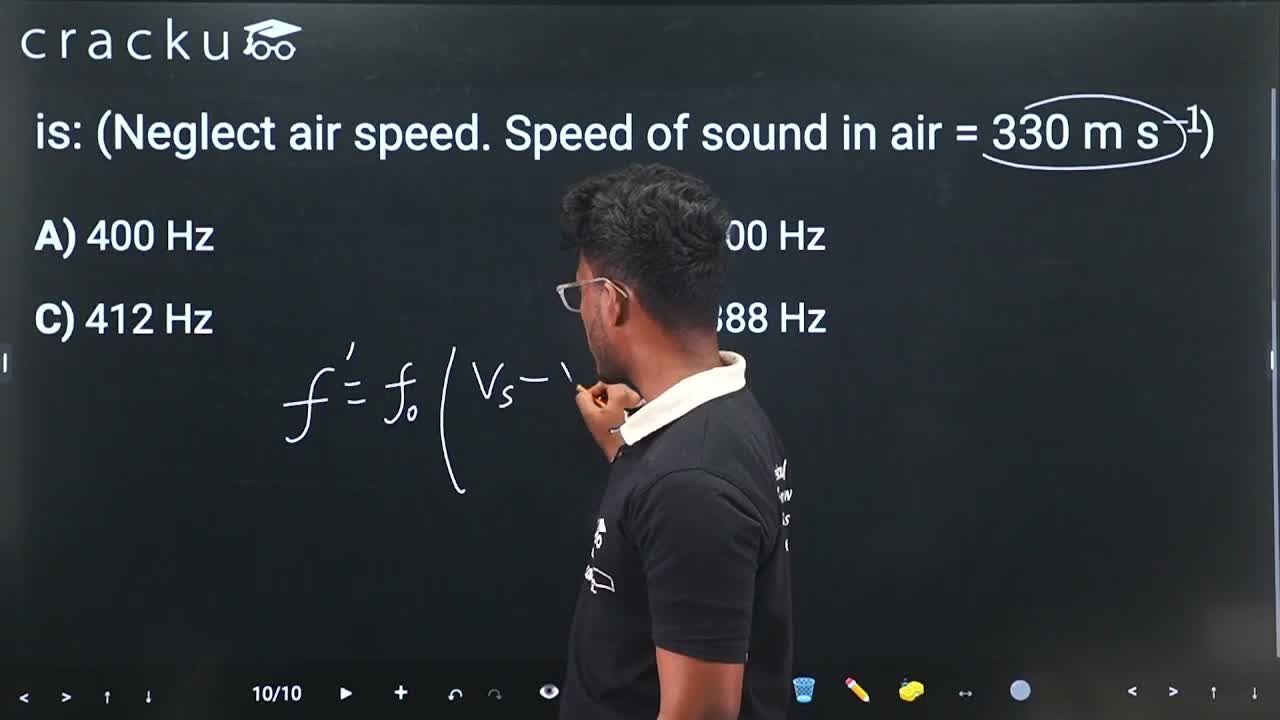
The engine of a train moving with speed 10 m s$$^{-1}$$ towards a platform sounds a whistle at frequency 400 Hz. The frequency heard by a passenger inside the train is: (Neglect air speed. Speed of sound in air = 330 m s$$^{-1}$$)
We need to find the frequency heard by a passenger inside the train.
Identify source and observer. The source of sound is the engine of the train, and the observer (passenger) is also inside the same train.
Key concept — relative motion. Both the source (engine) and the observer (passenger) are moving together at the same speed (10 m/s). There is no relative motion between them.
Apply the Doppler effect. When there is no relative motion between the source and the observer, the observed frequency equals the emitted frequency:
$$f_{\text{observed}} = f_{\text{source}} = 400 \text{ Hz}$$
Note: The Doppler effect only applies when there is relative motion between the source and the observer through the medium. Since the passenger is on the same train as the engine, they move together and hear the original frequency.
The correct answer is Option A: 400 Hz.
Was this solution helpful?
Click on the Email ☝️ to Watch the Video Solution
Create a FREE account and get:
_1.webp)

Educational materials for JEE preparation

Ask our AI anything

AI can make mistakes. Please verify important information.
AI can make mistakes. Please verify important information.
