
Join Our JEE Preparation Group
Prep with like-minded aspirants; Get access to free daily tests and study material.
Sign in
Please select an account to continue using cracku.in
↓ →
Join Our JEE Preparation Group
Prep with like-minded aspirants; Get access to free daily tests and study material.
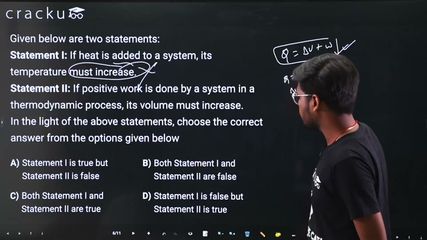
Given below are two statements:
Statement I: If heat is added to a system, its temperature must increase.
Statement II: If positive work is done by a system in a thermodynamic process, its volume must increase.
In the light of the above statements, choose the correct answer from the options given below
We need to evaluate two statements about thermodynamics.
Statement I: "If heat is added to a system, its temperature must increase."
This is FALSE. Consider the following counterexamples:
- During a phase change (e.g., melting of ice at 0°C), heat is added but the temperature remains constant.
- In an isothermal expansion of an ideal gas, heat is added to do work, but the temperature stays constant.
Statement II: "If positive work is done by a system in a thermodynamic process, its volume must increase."
This is FALSE. Consider these counterexamples:
- In a cyclic process, the system can perform net positive work while the volume returns to its original value.
- A system may do non-expansion (non-PdV) work, such as electrical work, without any change in volume.
Since both statements are false, the correct answer is Option B: Both Statement I and Statement II are false.
Was this solution helpful?
Click on the Email ☝️ to Watch the Video Solution
Create a FREE account and get:
_1.webp)

Educational materials for JEE preparation

Ask our AI anything

AI can make mistakes. Please verify important information.
AI can make mistakes. Please verify important information.
