
Join Our JEE Preparation Group
Prep with like-minded aspirants; Get access to free daily tests and study material.
Sign in
Please select an account to continue using cracku.in
↓ →
Join Our JEE Preparation Group
Prep with like-minded aspirants; Get access to free daily tests and study material.
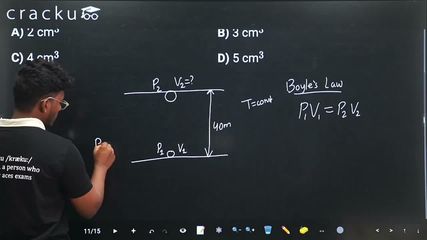
An air bubble of volume 1 cm$$^3$$ rises from the bottom of a lake 40 m deep to the surface at a temperature of 12°C. The atmospheric pressure is $$1 \times 10^5$$ Pa, the density of water is 1000 kg m$$^{-3}$$ and $$g = 10$$ m s$$^{-2}$$. There is no difference of the temperature of water at the depth of 40 m and on the surface. The volume of air bubble when it reaches the surface will be
We need to find the volume of an air bubble when it reaches the surface from 40 m depth.
Apply Boyle's Law (constant temperature). Since the temperature is the same at the bottom and surface:
$$P_1 V_1 = P_2 V_2$$
Calculate pressure at the bottom: $$P_1 = P_{\text{atm}} + \rho g h = 1 \times 10^5 + 1000 \times 10 \times 40 = 1 \times 10^5 + 4 \times 10^5 = 5 \times 10^5 \text{ Pa}$$
Pressure at the surface: $$P_2 = P_{\text{atm}} = 1 \times 10^5 \text{ Pa}$$
Calculate the volume at the surface: $$V_2 = V_1 \times \frac{P_1}{P_2} = 1 \times \frac{5 \times 10^5}{1 \times 10^5} = 5 \text{ cm}^3$$
The correct answer is Option D: 5 cm$$^3$$.
Click on the Email ☝️ to Watch the Video Solution
Create a FREE account and get:
_1.webp)

Educational materials for JEE preparation

Ask our AI anything

AI can make mistakes. Please verify important information.
AI can make mistakes. Please verify important information.


