
Join Our JEE Preparation Group
Prep with like-minded aspirants; Get access to free daily tests and study material.
Sign in
Please select an account to continue using cracku.in
↓ →
Join Our JEE Preparation Group
Prep with like-minded aspirants; Get access to free daily tests and study material.
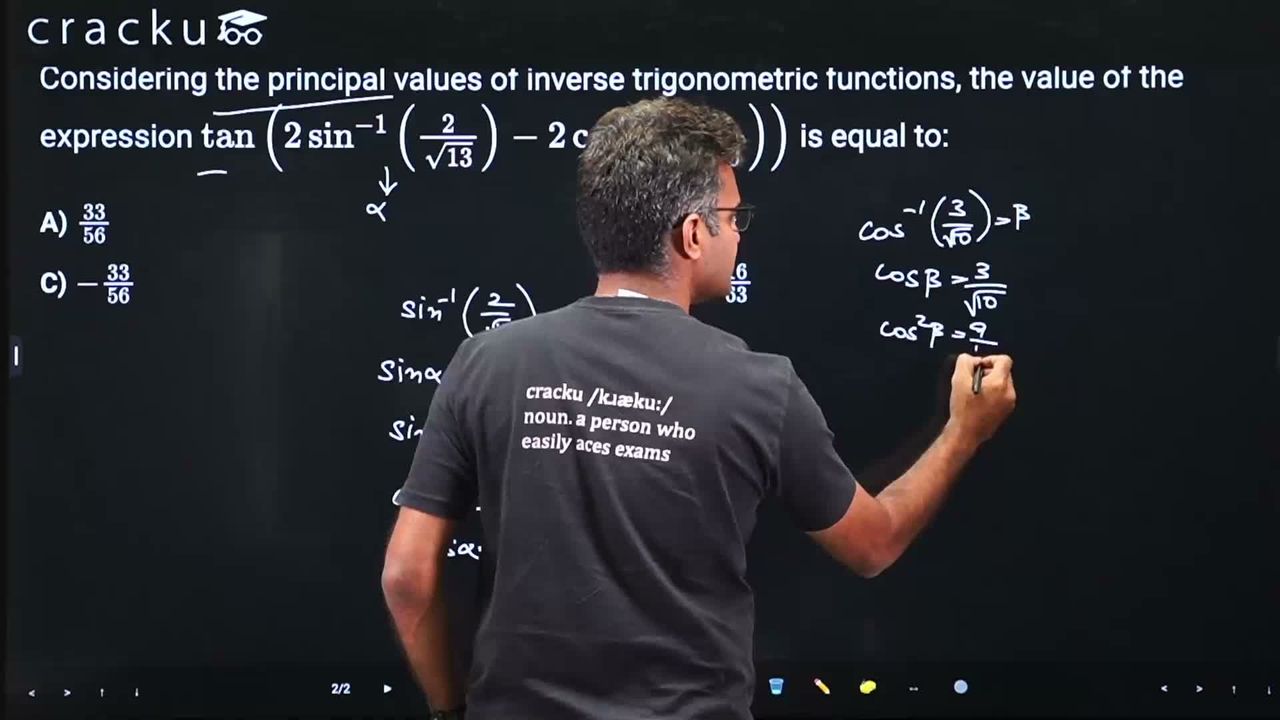
Considering the principal values of inverse trigonometric functions, the value of the expression $$\tan \left( 2 \sin^{-1} \left( \frac{2}{\sqrt{13}} \right) - 2 \cos^{-1} \left( \frac{3}{\sqrt{10}} \right) \right)$$ is equal to:
Let $$\alpha = \sin^{-1}\left(\frac{2}{\sqrt{13}}\right)$$ and $$\beta = \cos^{-1}\left(\frac{3}{\sqrt{10}}\right)$$. The expression becomes $$\tan\left(2(\alpha - \beta)\right)$$.
First, find $$\tan\alpha$$ and $$\tan\beta$$.
For $$\alpha$$:
Given $$\sin\alpha = \frac{2}{\sqrt{13}}$$, use $$\sin^2\alpha + \cos^2\alpha = 1$$:
$$\cos^2\alpha = 1 - \left(\frac{2}{\sqrt{13}}\right)^2 = 1 - \frac{4}{13} = \frac{9}{13}$$.
Since $$\alpha$$ is in the first quadrant (principal value of $$\sin^{-1}$$), $$\cos\alpha = \frac{3}{\sqrt{13}}$$.
Thus, $$\tan\alpha = \frac{\sin\alpha}{\cos\alpha} = \frac{2/\sqrt{13}}{3/\sqrt{13}} = \frac{2}{3}$$.
For $$\beta$$:
Given $$\cos\beta = \frac{3}{\sqrt{10}}$$, use $$\sin^2\beta + \cos^2\beta = 1$$:
$$\sin^2\beta = 1 - \left(\frac{3}{\sqrt{10}}\right)^2 = 1 - \frac{9}{10} = \frac{1}{10}$$.
Since $$\beta$$ is in the first quadrant (principal value of $$\cos^{-1}$$), $$\sin\beta = \frac{1}{\sqrt{10}}$$.
Thus, $$\tan\beta = \frac{\sin\beta}{\cos\beta} = \frac{1/\sqrt{10}}{3/\sqrt{10}} = \frac{1}{3}$$.
Now, find $$\tan(\alpha - \beta)$$ using the tangent subtraction formula:
$$\tan(\alpha - \beta) = \frac{\tan\alpha - \tan\beta}{1 + \tan\alpha \tan\beta} = \frac{\frac{2}{3} - \frac{1}{3}}{1 + \left(\frac{2}{3}\right)\left(\frac{1}{3}\right)} = \frac{\frac{1}{3}}{1 + \frac{2}{9}} = \frac{\frac{1}{3}}{\frac{11}{9}} = \frac{1}{3} \times \frac{9}{11} = \frac{3}{11}$$.
Let $$\theta = \alpha - \beta$$, so $$\tan\theta = \frac{3}{11}$$. Now find $$\tan(2\theta)$$ using the double-angle formula:
$$\tan(2\theta) = \frac{2\tan\theta}{1 - \tan^2\theta} = \frac{2 \times \frac{3}{11}}{1 - \left(\frac{3}{11}\right)^2} = \frac{\frac{6}{11}}{1 - \frac{9}{121}} = \frac{\frac{6}{11}}{\frac{112}{121}} = \frac{6}{11} \times \frac{121}{112} = \frac{6 \times 121}{11 \times 112}$$.
Simplify:
$$\frac{6 \times 121}{11 \times 112} = \frac{6 \times 11 \times 11}{11 \times 112} = \frac{6 \times 11}{112} = \frac{66}{112}$$.
Reduce by dividing numerator and denominator by 2:
$$\frac{66 \div 2}{112 \div 2} = \frac{33}{56}$$.
Since $$\alpha$$ and $$\beta$$ are both acute and $$\tan\alpha = \frac{2}{3} > \tan\beta = \frac{1}{3}$$, it follows that $$\alpha > \beta$$, so $$\theta = \alpha - \beta > 0$$. Thus, $$2\theta$$ is in the first quadrant where tangent is positive.
The value is $$\frac{33}{56}$$, which corresponds to option A.
Was this solution helpful?
Click on the Email ☝️ to Watch the Video Solution
Create a FREE account and get:
_1.webp)

Educational materials for JEE preparation

Ask our AI anything

AI can make mistakes. Please verify important information.
AI can make mistakes. Please verify important information.
