
Join Our JEE Preparation Group
Prep with like-minded aspirants; Get access to free daily tests and study material.
Sign in
Please select an account to continue using cracku.in
↓ →
Join Our JEE Preparation Group
Prep with like-minded aspirants; Get access to free daily tests and study material.
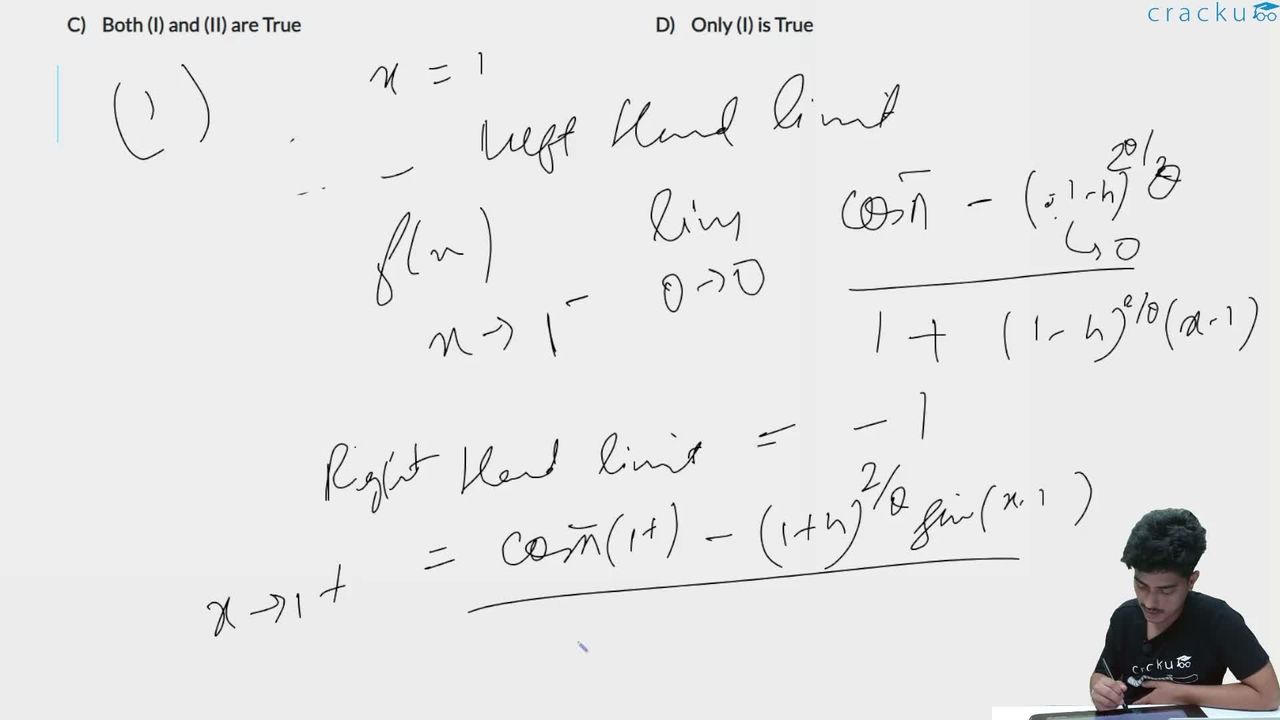
Let $$f(x) = \lim_{\theta \to 0}\left(\frac{\cos\pi x - x^{\frac{2}{\theta}} \sin(x - 1)}{1 + x^{\left(\frac{2}{\theta}\right)} (x - 1)}\right), \quad x \in \mathbb{R}$$. Consider the following two statements :
(I) $$f(x)$$ is discontinuous at $$x=1$$.
(II) $$f(x)$$ is continuous at $$x= - 1$$.
Then,
Let $$k = \lim_{\theta \to 0} x^{\frac{2}{\theta}}$$. The behavior of $$f(x)$$ depends on the value of $$|x|$$:
• If $$|x| < 1$$, $$x^{\frac{2}{\theta}} \to 0$$ as $$\theta \to 0$$. Then $$f(x) = \cos \pi x$$.
• If $$|x| > 1$$, $$x^{\frac{2}{\theta}} \to \infty$$. Dividing numerator and denominator by $$x^{\frac{2}{\theta}}$$, $$f(x) = \frac{-\sin(x-1)}{x-1}$$.
• If $$x = 1$$, $$f(1) = \frac{\cos \pi - 0}{1 + 0} = -1$$.
• If $$x = -1$$, $$f(-1) = \frac{\cos(-\pi) - (1)\sin(-2)}{1 + (1)(-2)} = \frac{-1 + \sin 2}{-1} = 1 - \sin 2$$.
Checking Statements:
1. At $$x=1$$: $$\lim_{x \to 1^-} \cos \pi x = -1$$ and $$\lim_{x \to 1^+} \frac{-\sin(x-1)}{x-1} = -1$$. Since $$LHL = RHL = f(1)$$, the function is continuous at $$x=1$$. Statement (I) is False.
2. At $$x=-1$$: $$\lim_{x \to -1^+} \cos \pi x = -1$$. But $$f(-1) = 1 - \sin 2$$. Since they aren't equal, it is discontinuous. Statement (II) is False.
Correct Option: A (Neither (I) nor (II) is True)
Was this solution helpful?
Click on the Email ☝️ to Watch the Video Solution
Create a FREE account and get:
_1.webp)

Educational materials for JEE preparation

Ask our AI anything

AI can make mistakes. Please verify important information.
AI can make mistakes. Please verify important information.
