
Join Our JEE Preparation Group
Prep with like-minded aspirants; Get access to free daily tests and study material.
Sign in
Please select an account to continue using cracku.in
↓ →
Join Our JEE Preparation Group
Prep with like-minded aspirants; Get access to free daily tests and study material.
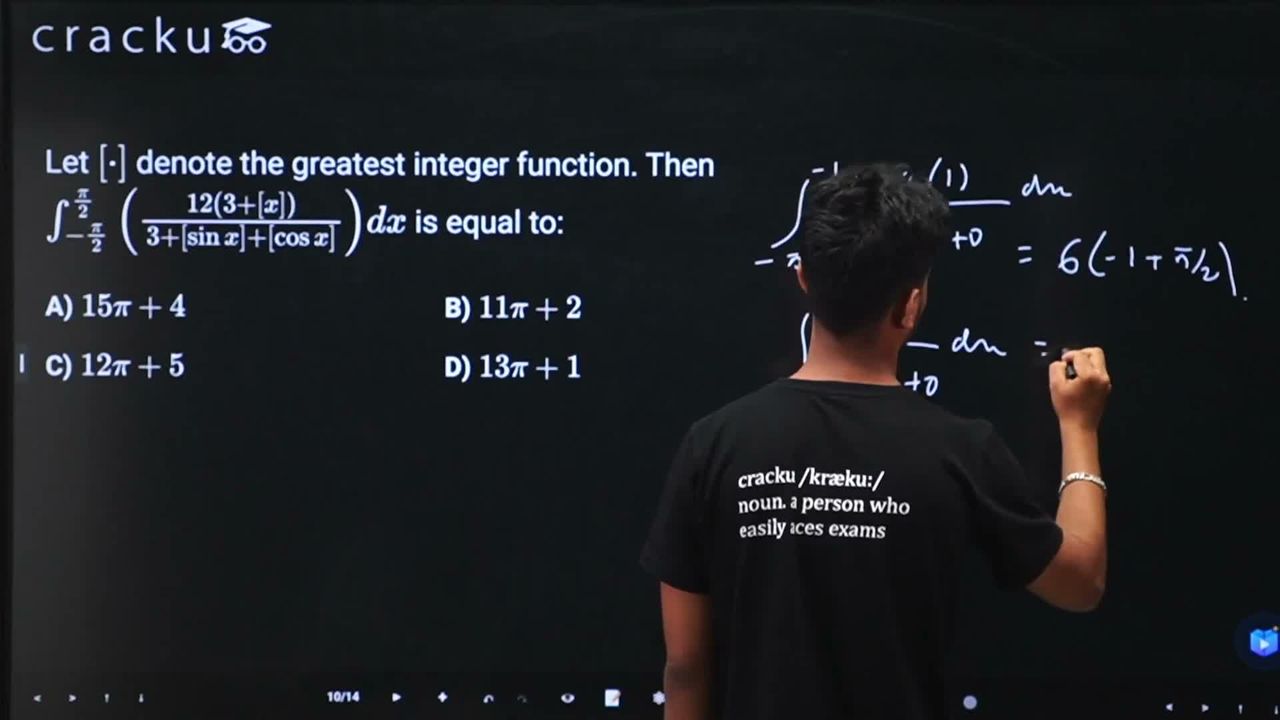
Let $$[\cdot]$$ denote the greatest integer function. Then $$\int_{-\frac{\pi}{2}}^{\frac{\pi}{2}} \left(\frac{12(3+[x])}{3+[\sin x]+[\cos x]}\right)dx$$ is equal to:
The integral to evaluate is $$\int_{-\frac{\pi}{2}}^{\frac{\pi}{2}} \left(\frac{12(3+[x])}{3+[\sin x]+[\cos x]}\right)dx$$, where $$[\cdot]$$ denotes the greatest integer function.
The interval $$[-\frac{\pi}{2}, \frac{\pi}{2}]$$ is divided into subintervals based on the values of $$[x]$$, $$[\sin x]$$, and $$[\cos x]$$, which are constant in each subinterval. The subintervals and the corresponding values are determined as follows:
- For $$x \in [-\frac{\pi}{2}, -1)$$: $$[x] = -2$$, $$[\sin x] = -1$$, $$[\cos x] = 0$$.
Denominator: $$3 + (-1) + 0 = 2$$.
Numerator: $$12(3 + (-2)) = 12 \times 1 = 12$$.
So, the integrand is $$\frac{12}{2} = 6$$.
- For $$x \in [-1, 0)$$: $$[x] = -1$$, $$[\sin x] = -1$$, $$[\cos x] = 0$$.
Denominator: $$3 + (-1) + 0 = 2$$.
Numerator: $$12(3 + (-1)) = 12 \times 2 = 24$$.
So, the integrand is $$\frac{24}{2} = 12$$.
- For $$x \in [0, 1)$$: $$[x] = 0$$, $$[\sin x] = 0$$, $$[\cos x] = 0$$.
Denominator: $$3 + 0 + 0 = 3$$.
Numerator: $$12(3 + 0) = 12 \times 3 = 36$$.
So, the integrand is $$\frac{36}{3} = 12$$.
- For $$x \in [1, \frac{\pi}{2}]$$: $$[x] = 1$$, $$[\sin x] = 0$$ for $$x \in [1, \frac{\pi}{2})$$, $$[\cos x] = 0$$.
Denominator: $$3 + 0 + 0 = 3$$.
Numerator: $$12(3 + 1) = 12 \times 4 = 48$$.
So, the integrand is $$\frac{48}{3} = 16$$ (and at $$x = \frac{\pi}{2}$$, it is 12, but this point has measure zero).
The integral is split accordingly:
$$\int_{-\frac{\pi}{2}}^{\frac{\pi}{2}} f(x) dx = \int_{-\frac{\pi}{2}}^{-1} 6 dx + \int_{-1}^{0} 12 dx + \int_{0}^{1} 12 dx + \int_{1}^{\frac{\pi}{2}} 16 dx$$
Evaluating each integral:
- $$\int_{-\frac{\pi}{2}}^{-1} 6 dx = 6 \left[ x \right]_{-\frac{\pi}{2}}^{-1} = 6 \left[ -1 - \left(-\frac{\pi}{2}\right) \right] = 6 \left( -1 + \frac{\pi}{2} \right) = -6 + 3\pi$$
- $$\int_{-1}^{0} 12 dx = 12 \left[ x \right]_{-1}^{0} = 12 \left[ 0 - (-1) \right] = 12 \times 1 = 12$$
- $$\int_{0}^{1} 12 dx = 12 \left[ x \right]_{0}^{1} = 12 \left( 1 - 0 \right) = 12$$
- $$\int_{1}^{\frac{\pi}{2}} 16 dx = 16 \left[ x \right]_{1}^{\frac{\pi}{2}} = 16 \left( \frac{\pi}{2} - 1 \right) = 16 \times \frac{\pi}{2} - 16 \times 1 = 8\pi - 16$$
Summing these results:
$$(-6 + 3\pi) + 12 + 12 + (8\pi - 16) = 3\pi + 8\pi + (-6 + 12 + 12 - 16) = 11\pi + (24 - 22) = 11\pi + 2$$
Thus, the integral evaluates to $$11\pi + 2$$.
Was this solution helpful?
Click on the Email ☝️ to Watch the Video Solution
Create a FREE account and get:
_1.webp)

Educational materials for JEE preparation

Ask our AI anything

AI can make mistakes. Please verify important information.
AI can make mistakes. Please verify important information.
