
Join Our JEE Preparation Group
Prep with like-minded aspirants; Get access to free daily tests and study material.
Sign in
Please select an account to continue using cracku.in
↓ →
Join Our JEE Preparation Group
Prep with like-minded aspirants; Get access to free daily tests and study material.
Let $$\alpha = \displaystyle\sum_{k=1}^{\infty} \sin^{2k}\left(\dfrac{\pi}{6}\right)$$.
Let $$g : [0, 1] \to \mathbb{R}$$ be the function defined by $$g(x) = 2^{\alpha x} + 2^{\alpha(1-x)}$$.
Then, which of the following statements is False?
The series $$\alpha = \displaystyle\sum_{k=1}^{\infty} \sin^{2k}\!\left(\frac{\pi}{6}\right)$$ is a geometric progression.
Since $$\sin\!\left(\frac{\pi}{6}\right)=\frac12$$, we get the common ratio
$$r = \left(\frac12\right)^{2}= \frac14.$$
For an infinite GP, $$S_\infty=\dfrac{ar}{1-r}$$ where $$a$$ is the first term.
Here the first term is also $$\dfrac14$$, so
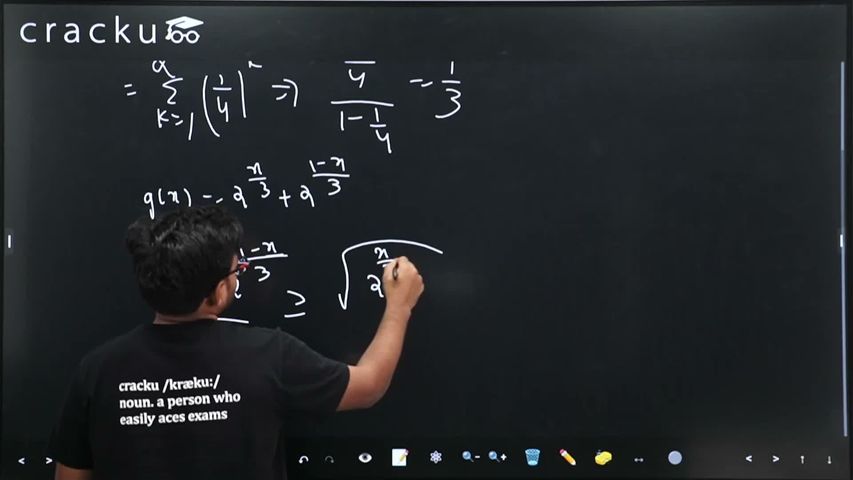
$$\alpha = \frac{\tfrac14}{1-\tfrac14}= \frac{\tfrac14}{\tfrac34}= \frac13.$$
Hence $$g(x)=2^{\alpha x}+2^{\alpha(1-x)}=2^{x/3}+2^{(1-x)/3},\qquad 0\le x\le 1.$$
Write $$g(x)=f(x)+f(1-x)$$ with $$f(x)=2^{x/3}.$$ Because $$f(x)$$ is strictly increasing, $$f(1-x)$$ is strictly decreasing, and $$g(x)=g(1-x),$$ the graph is symmetric about $$x=\tfrac12.$$
Differentiate:
$$g'(x)=\frac{\ln 2}{3}\Bigl(2^{x/3}-2^{(1-x)/3}\Bigr).$$
Set $$g'(x)=0$$:
$$2^{x/3}=2^{(1-x)/3}\;\Longrightarrow\;x=1-x\;\Longrightarrow\;x=\frac12.$$
Second derivative:
$$g''(x)=\left(\frac{\ln 2}{3}\right)^2\!\Bigl(2^{x/3}+2^{(1-x)/3}\Bigr)\gt 0\;\text{for all }x,$$
so $$x=\tfrac12$$ gives a minimum.
Minimum value:
$$g\!\left(\frac12\right)=2^{(1/2)/3}+2^{(1-1/2)/3}=2^{1/6}+2^{1/6}=2\cdot2^{1/6}=2^{7/6}.$$
Because $$g(x)$$ is decreasing on $$[0,\tfrac12]$$ and increasing on $$[\tfrac12,1]$$, the largest values occur at the endpoints $$x=0$$ and $$x=1$$ (symmetry). Compute
$$g(0)=2^{0}+2^{1/3}=1+2^{1/3},\qquad g(1)=2^{1/3}+2^{0}=1+2^{1/3}.$$
Thus
• Minimum value = $$2^{7/6}$$, attained only at $$x=\tfrac12.$br/> • Maximum value = $$1+2^{1/3}$$, attained at both $$x=0$$ and $$x=1.$$
Therefore:
Option A is TRUE. (Minimum is $$2^{7/6}$$.)
Option B is TRUE. (Maximum is $$1+2^{1/3}$$.)
Option C is TRUE. (Maximum occurs at two points, 0 and 1.)
Option D is FALSE. (Minimum occurs only at a single point, $$x=\tfrac12$$.)
Was this solution helpful?
Click on the Email ☝️ to Watch the Video Solution
Create a FREE account and get:
_1.webp)

Educational materials for JEE preparation

Ask our AI anything

AI can make mistakes. Please verify important information.
AI can make mistakes. Please verify important information.
