
Join Our JEE Preparation Group
Prep with like-minded aspirants; Get access to free daily tests and study material.
Sign in
Please select an account to continue using cracku.in
↓ →
Join Our JEE Preparation Group
Prep with like-minded aspirants; Get access to free daily tests and study material.
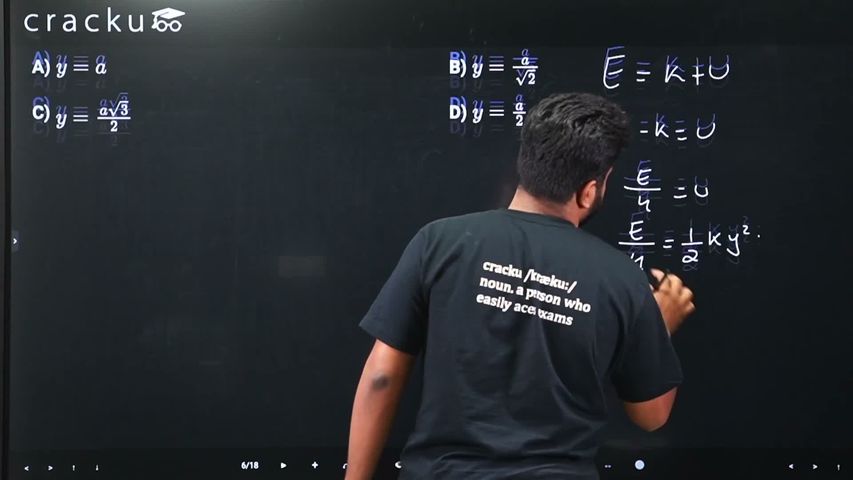
A particle starts executing simple harmonic motion (SHM) of amplitude $$a$$ and total energy $$E$$. At any instant, its kinetic energy is $$\frac{3E}{4}$$, then its displacement $$y$$ is given by:
For a particle in simple harmonic motion, the total mechanical energy is the sum of its kinetic and potential energies. The standard results are:
• Total energy $$E = \dfrac{1}{2}\,k\,a^{2}$$ where $$k$$ is the spring (force) constant and $$a$$ is the amplitude.
• Potential energy at displacement $$y$$ from the mean position $$U = \dfrac{1}{2}\,k\,y^{2}$$.
• Kinetic energy at the same instant $$K = E - U$$.
We are told that at some instant the kinetic energy is
$$K = \dfrac{3E}{4}.$$
Using the relation $$K = E - U$$, we substitute the given value:
$$E - U = \dfrac{3E}{4}.$$
Rearranging, we find the potential energy at that instant:
$$U = E - \dfrac{3E}{4} = \dfrac{E}{4}.$$
Now we equate this to the expression for potential energy in SHM:
$$\dfrac{1}{2}\,k\,y^{2} = \dfrac{E}{4}.$$
But the total energy is $$E = \dfrac{1}{2}\,k\,a^{2}$$, so we substitute $$E$$ on the right-hand side:
$$\dfrac{1}{2}\,k\,y^{2} = \dfrac{1}{4}\left(\dfrac{1}{2}\,k\,a^{2}\right).$$
We observe that the factor $$\dfrac{1}{2}\,k$$ appears on both sides, allowing us to cancel it out completely:
$$y^{2} = \dfrac{a^{2}}{4}.$$
Taking the principal value of the square root (the question asks for the magnitude of displacement), we obtain
$$y = \dfrac{a}{2}.$$
Hence, the correct answer is Option D.
Was this solution helpful?
Click on the Email ☝️ to Watch the Video Solution
Create a FREE account and get:
_1.webp)

Educational materials for JEE preparation

Ask our AI anything

AI can make mistakes. Please verify important information.
AI can make mistakes. Please verify important information.
