
Join Our JEE Preparation Group
Prep with like-minded aspirants; Get access to free daily tests and study material.
Sign in
Please select an account to continue using cracku.in
↓ →
Join Our JEE Preparation Group
Prep with like-minded aspirants; Get access to free daily tests and study material.
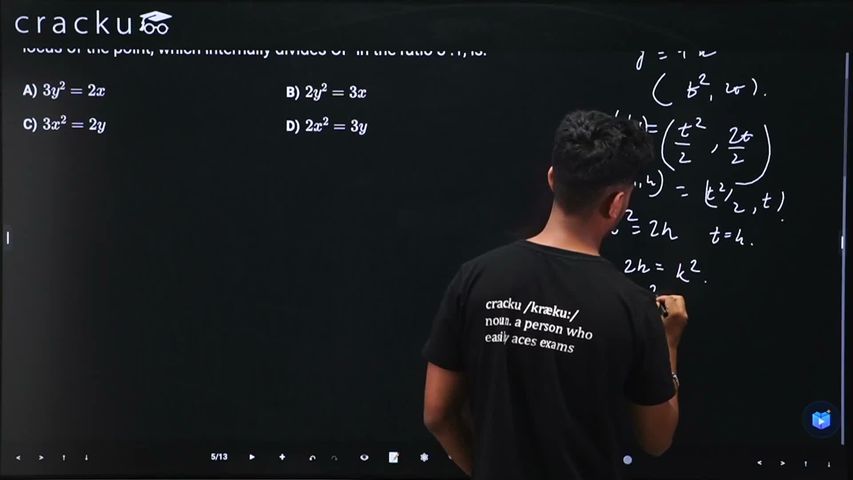
Let the locus of the mid-point of the chord through the origin O of the parabola $$y^{2}= 4x$$ be the curve S. Let P be any point on S. Then the locus of the point, which internally divides OP in the ratio 3 :1, is:
the standard form $$y^{2}=4ax$$ gives $$a=1$$.
Equation of a chord of the parabola whose mid-point is $$(h,k)$$.
For $$y^{2}=4ax$$ the formula for the chord with mid-point $$(h,k)$$ is
$$k\,y-2a\,(x+h)=k^{2}-4a\,h \qquad -(1)$$
(This is the result $$T=S_{1}$$ for a parabola.)
Condition that the chord passes through the origin $$O(0,0)$$.
Substitute $$x=0,\;y=0$$ in $$(1)$$:
$$0\cdot k-2a(0+h)=k^{2}-4a\,h$$
$$-2a\,h=k^{2}-4a\,h$$
$$k^{2}=2a\,h \qquad -(2)$$
With $$a=1$$, (2) becomes $$k^{2}=2h$$.
Hence the locus of the mid-point $$P(h,k)$$ of every chord through the origin is
$$y^{2}=2x$$.
This curve is denoted by $$S$$.
Coordinates of the point which divides $$OP$$ internally in the ratio $$3:1$$.
For points $$O(0,0)$$ and $$P(h,k)$$, the section point $$G(x,y)$$ with
$$\frac{OG}{GP}=3:1$$ is
$$x=\frac{3h+1\cdot 0}{3+1}=\frac{3h}{4}, \quad
y=\frac{3k+1\cdot 0}{3+1}=\frac{3k}{4} \qquad -(3)$$
$$h=\frac{4x}{3},\;k=\frac{4y}{3}$$.
Insert $$h=\frac{4x}{3},\;k=\frac{4y}{3}$$ into the relation $$k^{2}=2h$$:
$$\left(\frac{4y}{3}\right)^{2}=2\left(\frac{4x}{3}\right)$$
$$\frac{16y^{2}}{9}=\frac{8x}{3}$$
$$2y^{2}=3x$$.
the locus of the point dividing $$OP$$ in the ratio $$3:1$$ is $$\boxed{2y^{2}=3x}$$, which corresponds to Option B.
Was this solution helpful?
Click on the Email ☝️ to Watch the Video Solution
Create a FREE account and get:
_1.webp)

Educational materials for JEE preparation

Ask our AI anything

AI can make mistakes. Please verify important information.
AI can make mistakes. Please verify important information.
