
Join Our JEE Preparation Group
Prep with like-minded aspirants; Get access to free daily tests and study material.
Sign in
Please select an account to continue using cracku.in
↓ →
Join Our JEE Preparation Group
Prep with like-minded aspirants; Get access to free daily tests and study material.
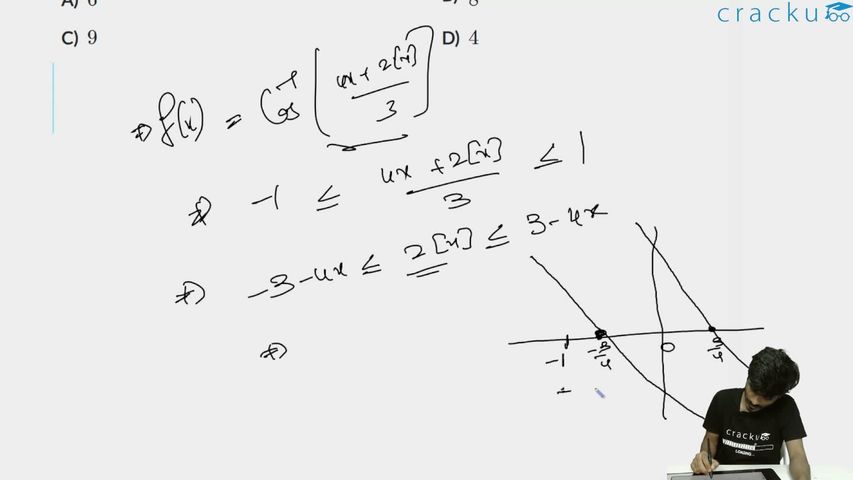
Let $$[\cdot]$$ denote the greatest integer function. If the domain of $$f(x) = \cos^{-1}\left(\frac{4x + 2[x]}{3}\right)$$ is $$[\alpha, \beta]$$, then $$12(\alpha + \beta)$$ is equal to :
For $$f(x)=\cos^{-1}\!\left(\dfrac{4x+2[x]}{3}\right)$$ the inside value of the $$\cos^{-1}$$ must lie between $$-1$$ and $$1$$ inclusive.
Let $$[x]=n$$, where $$n$$ is an integer and $$n\le x\lt n+1$$.
Then the required inequality is
$$-1\le\dfrac{4x+2n}{3}\le 1$$
Multiplying by $$3$$ gives two simultaneous inequalities
$$-3\le 4x+2n\le 3$$ $$-(1)$$
Re-arranging each side of $$(1)$$:
Left side $$\Rightarrow$$ $$4x\ge -3-2n \;\Rightarrow\; x\ge\dfrac{-3-2n}{4}$$
Right side $$\Rightarrow$$ $$4x\le 3-2n \;\Rightarrow\; x\le\dfrac{3-2n}{4}$$
Thus, for a fixed integer $$n$$ the admissible $$x$$-interval is
$$\left[\dfrac{-3-2n}{4},\,\dfrac{3-2n}{4}\right]$$
But we must also respect the definition of the greatest-integer function: $$n\le x\lt n+1$$.
Hence the actual interval for a given $$n$$ is the intersection
$$\bigl[n,\,n+1\bigr)\;\cap\;\left[\dfrac{-3-2n}{4},\,\dfrac{3-2n}{4}\right]$$
For the intersection to be non-empty we need both
$$\dfrac{-3-2n}{4}\lt n+1$$ and $$\dfrac{3-2n}{4}\gt n$$
1. $$\dfrac{-3-2n}{4}\lt n+1$$ $$\Longrightarrow$$ $$-3-2n\lt 4n+4$$
$$\Longrightarrow -7-6n\lt 0 \Longrightarrow n\gt -\dfrac{7}{6}\,.$$
Thus $$n\ge -1$$.
2. $$\dfrac{3-2n}{4}\gt n$$ $$\Longrightarrow$$ $$3-2n\gt 4n$$
$$\Longrightarrow 3-6n\gt 0 \Longrightarrow n\lt \dfrac12\,.$$
Thus $$n\le 0$$.
Combining, the only possible integer values are $$n=-1,\,0$$.
Case -1:
$$n=-1,\;x\in[-1,0).$$
Admissible $$x$$ interval: $$\left[\dfrac{-3-2(-1)}{4},\,\dfrac{3-2(-1)}{4}\right]=\left[-\dfrac14,\,\dfrac54\right].$$
Intersecting with $$[-1,0)$$ gives $$\bigl[-\dfrac14,\,0\bigr)$$.
Case 0:
$$n=0,\;x\in[0,1).$$
Admissible $$x$$ interval: $$\left[\dfrac{-3}{4},\,\dfrac34\right].$$
Intersecting with $$[0,1)$$ gives $$\bigl[0,\,\dfrac34\bigr]$$.
Therefore the complete domain of $$f(x)$$ is
$$\bigl[-\dfrac14,\,0\bigr)\;\cup\;\bigl[0,\,\dfrac34\bigr]=\bigl[-\dfrac14,\,\dfrac34\bigr].$$
Hence $$\alpha=-\dfrac14,\;\beta=\dfrac34\;$$ and
$$12(\alpha+\beta)=12\!\left(-\dfrac14+\dfrac34\right)=12\!\left(\dfrac12\right)=6.$$
Option A which is: $$6$$
Was this solution helpful?
Click on the Email ☝️ to Watch the Video Solution
Create a FREE account and get:
_1.webp)

Educational materials for JEE preparation

Ask our AI anything

AI can make mistakes. Please verify important information.
AI can make mistakes. Please verify important information.


