
Join Our JEE Preparation Group
Prep with like-minded aspirants; Get access to free daily tests and study material.
Sign in
Please select an account to continue using cracku.in
↓ →
Join Our JEE Preparation Group
Prep with like-minded aspirants; Get access to free daily tests and study material.
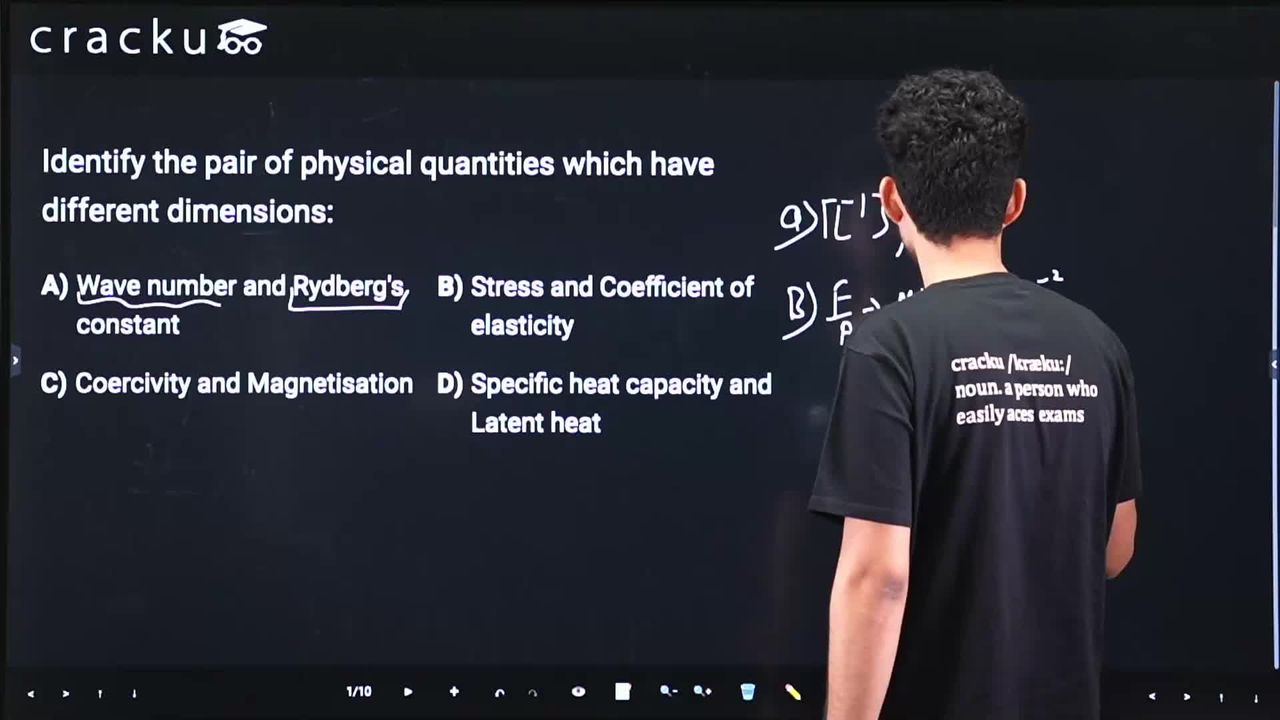
Identify the pair of physical quantities which have different dimensions:
We need to identify the pair of physical quantities that have different dimensions.
Option A: Wave number and Rydberg's constant
Wave number $$k = \frac{1}{\lambda}$$, so its dimension is $$[L^{-1}]$$.
Rydberg's constant $$R$$ also has dimension $$[L^{-1}]$$ (it appears in $$\frac{1}{\lambda} = R\left(\frac{1}{n_1^2} - \frac{1}{n_2^2}\right)$$).
Both have the same dimensions.
Option B: Stress and Coefficient of elasticity
Stress $$= \frac{F}{A}$$, dimension $$= [ML^{-1}T^{-2}]$$.
Coefficient of elasticity (Young's modulus) $$= \frac{\text{Stress}}{\text{Strain}}$$. Since strain is dimensionless, its dimension is also $$[ML^{-1}T^{-2}]$$.
Both have the same dimensions.
Option C: Coercivity and Magnetisation
Both coercivity and magnetisation have the dimension of magnetic field intensity $$H$$, which is $$[AL^{-1}]$$.
Both have the same dimensions.
Option D: Specific heat capacity and Latent heat
Specific heat capacity $$c = \frac{Q}{m \Delta T}$$, dimension $$= \frac{[ML^2T^{-2}]}{[M][K]} = [L^2T^{-2}K^{-1}]$$.
Latent heat $$L = \frac{Q}{m}$$, dimension $$= \frac{[ML^2T^{-2}]}{[M]} = [L^2T^{-2}]$$.
These have different dimensions — specific heat capacity has an extra factor of $$K^{-1}$$.
Therefore, the correct answer is Option D.
Was this solution helpful?
Click on the Email ☝️ to Watch the Video Solution
Create a FREE account and get:
_1.webp)

Educational materials for JEE preparation

Ask our AI anything

AI can make mistakes. Please verify important information.
AI can make mistakes. Please verify important information.
