
Join Our JEE Preparation Group
Prep with like-minded aspirants; Get access to free daily tests and study material.
Sign in
Please select an account to continue using cracku.in
↓ →
Join Our JEE Preparation Group
Prep with like-minded aspirants; Get access to free daily tests and study material.
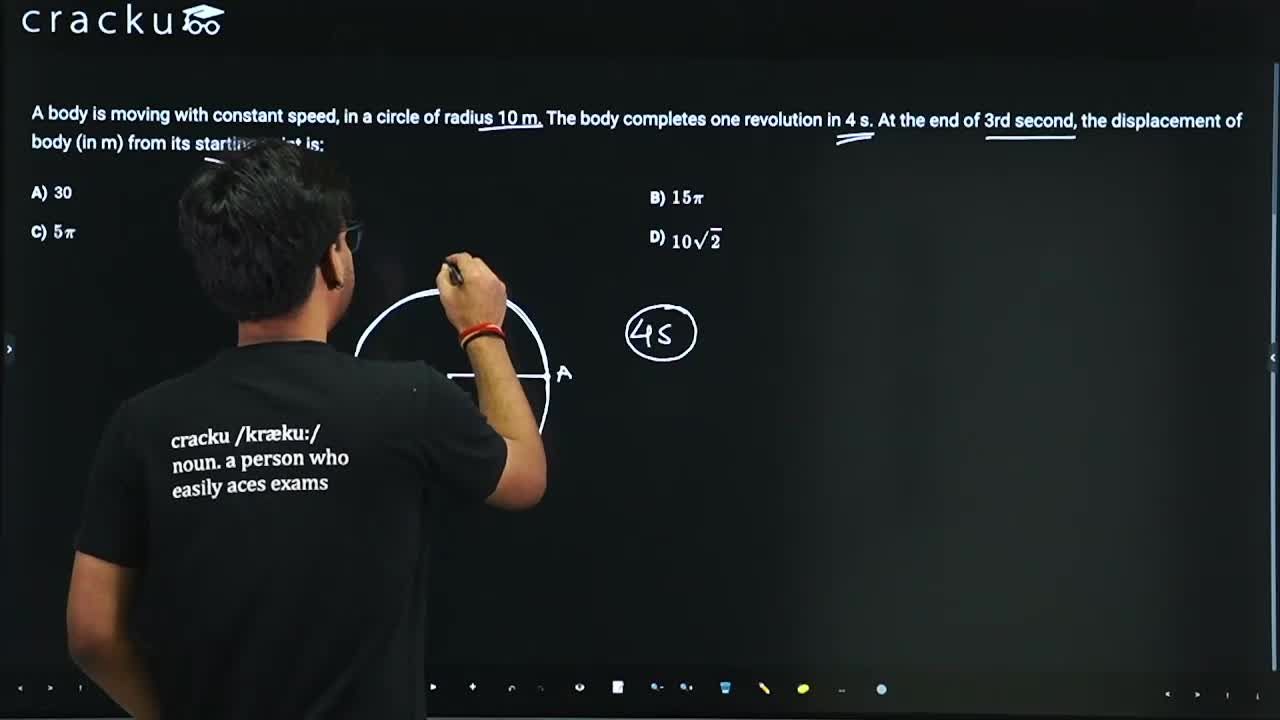
A body is moving with constant speed, in a circle of radius 10 m. The body completes one revolution in 4 s. At the end of 3rd second, the displacement of body (in m) from its starting point is:
The body moves in a circle of radius $$R = 10$$ m with period $$T = 4$$ s.
At $$t = 3$$ s, the fraction of revolution completed:
$$ \frac{t}{T} = \frac{3}{4} $$
This means the body has covered $$\frac{3}{4}$$ of a full circle, i.e., $$270°$$.
If the body starts at the top of the circle (say at angle $$0°$$), after $$270°$$ it is at the position that is $$90°$$ short of completing the circle.
The displacement is the straight-line distance from the starting point to the current position. For a $$270°$$ arc (or equivalently $$90°$$ measured the other way), the chord length is:
Using the chord formula $$d = 2R\sin(\theta/2)$$ where $$\theta = 270°$$:
$$ d = 2 \times 10 \times \sin(135°) = 20 \times \frac{\sqrt{2}}{2} = 10\sqrt{2} \text{ m} $$
Alternatively, the starting and ending points are separated by $$90°$$ on the circle (since $$360° - 270° = 90°$$), forming two perpendicular radii. The displacement = $$\sqrt{R^2 + R^2} = R\sqrt{2} = 10\sqrt{2}$$ m.
Was this solution helpful?
Click on the Email ☝️ to Watch the Video Solution
Create a FREE account and get:
_1.webp)

Educational materials for JEE preparation

Ask our AI anything

AI can make mistakes. Please verify important information.
AI can make mistakes. Please verify important information.
